A Master of Journalism and Mass Communication (MJMC) is a postgraduate degree developed for individuals who want to pursue a successful career in media, communication, or allied sectors. This study typically lasts two years and focuses on both academic understanding and practical skills required in today's rapidly changing media industry. Students study news reporting, media ethics, public relations, advertising, digital journalism, and broadcast media.
One of the most notable aspects of a MJMC curriculum is the emphasis on critical thinking, research, and communication skills. With the rise of digital platforms, the course now teaches students multimodal storytelling, content creation, and the use of current communication technologies. Workshops, internships, and live projects all provide additional real-world experience and increase employability.
After finishing the MJMC course, there are numerous and diverse career choices available. Graduates can pursue careers as journalists, editors, news anchors, public relations officers, content writers, media planners, advertising experts, or communication specialists in both public and commercial sectors. In addition, they can pursue academic or research positions in media studies.
Overall, a MJMC program is great for students who are passionate about media and communication, as it provides a platform for them to influence public opinion, successfully communicate knowledge, and make meaningful contributions to society.
MJMC Full Form
MJMC stands for Master of Journalism and Mass Communication. It is a 2-year postgraduate degree program that fosters advanced learning in Mass Media, print media, public relation, digital communication, and journalism.
MJMC Course Details
MJMC is a two-year postgraduate program that focuses on advanced knowledge and skills in media, journalism, and communications. The course is aimed at graduates who desire to work in print, broadcast, or digital media, as well as advertising, public relations, and corporate communication.
The MJMC Journalism and Mass Communication course curriculum covers a wide range of topics, including media law and ethics, reporting and editing, development communication, new media technologies, advertising techniques, and public relations management. With the expanding importance of digital platforms, students are also taught multimedia content development, social media management, and online journalism. Along with classroom instruction, the course emphasizes practical training through internships, workshops, field visits, and live projects, allowing students to gain industry experience.
Full Form
Master of Journalism and Mass Communication
Course Level
Postgraduate
Course Duration
2 Years (4 Semesters)
MJMC Eligibility
Bachelor’s degree in any discipline with minimum 50% aggregate marks. Good language proficiency and interest in media required.
Course Fee
INR 50,000 – 2,50,000 (varies by university)
Examination Type
Semester
Admission Process
Merit-based or Entrance Exam (varies by university)
Average MJMC Salary After Degree
INR 2.5 – 8 LPA (varies by profile & experience)
Recruiting Companies / Organizations After Degree
Times Group, NDTV, India Today, The Hindu, WPP Group, Ogilvy, PR Agencies, Digital Media Platforms, Corporate Communication Departments
MJMC Course Duration
The Master of Journalism and Mass Communication (MJMC) is of two (2) years, where the whole program is divided into 4 semester. The only reason to divide the course program into 4 semester is to make convenient for students to learn the theories and concepts with clarity.
Candidates must have a completed bachelor’s degree from a recognized university.
Minimum aggregate percentage should be at least 50% in graduation.
Students from any discipline like Political Science, History, Economics, English, etc. are eligible to pursue Master in Journalism in Mass Communication.
There are many universities that conduct entrance exam for getting admission in MJMC otherwise there are Universities who take admission on the basis of merit.
Good language proficiency is important aspect of MJMC, communication skills, and interest in media are essential.
MJMC Subjects & Syllabus
Here’s a structured table outlining the MJMC Subjects & Syllabus (general framework; may vary by university):
Semester
Core Subjects
Electives / Practical Training
Semester 1
Introduction to Mass Communication, History of Journalism, Media Laws & Ethics, Reporting & Editing
Practical in Print Media, Communication Skills Workshop
Semester 2
Development Communication, Advertising & Public Relations, Media Research Methods, Electronic Media (Radio & TV)
Practical in Radio/TV Production, Internship/Field Work
Semester 3
New Media & Digital Journalism, Corporate Communication, International Communication, Media Management
Practical in Online Journalism, Documentary/Short Film Production
Semester 4
Advanced Reporting, Media Criticism, Communication Theories, Dissertation/Project Work
Internship, Viva-Voce, Portfolio Development
MJMC Admission Process
It is very important to note that all universities have different process of admission to follow. But, roughly this blog will help you to understand the admission process:
Visit the University/College website
Apply online with the choice of your course program like MJMC
Submit the scan copy of your required documents
Do the online payment for the cost of the course
Receive an admission number and you are admitted for your course in MJMC
“Universities have different admission process. Hence, please visit the University website to follow the steps for the admission process.
MJMC Salary in India
The average salary ranges in India after completing an MJMC (Master of Journalism and Mass Communication):
Job Profiles
Average Salary (Per Annum)
Journalist / Reporter
INR 2.5 – 5 LPA
News Anchor / TV Correspondent
INR 4 – 8 LPA
Editor / Sub-Editor
INR 3 – 6 LPA
Public Relations Officer (PRO)
INR 3 – 7 LPA
Advertising Executive
INR 3 – 6 LPA
Content Writer / Copywriter
INR 2.5 – 5 LPA
Media Planner
INR 4 – 7 LPA
Corporate Communication Manager
INR 5 – 10 LPA
Digital Marketing Specialist
INR 3 – 6.5 LPA
Academician / Researcher
INR 3 – 6 LPA
Salaries may vary on the basis of skills, experience at hand, media platform (print, digital, or broadcast), and the hiring organization.
MJMC Course Fees
The fee structure for the Master of Journalism and Mass Communication (MJMC) differs between universities and is determined by the style of study, resources, and reputation of the institution. The average course fee in India is between INR 50,000 and INR 2,50,000 for a two-year program. Government and public universities typically charge cheaper fees than private colleges. Additional costs may include registration, test, and practical training. Many colleges also provide scholarships, cost discounts, and installment payment plans to qualified students. Overall, MJMC is regarded as an economical school with promising job prospects.
Career Paths or Job opportunity after Master in Journalism and Mass Communication
A Master of Journalism and Mass Communication (MJMC) degree provides up a wide range of job prospects in the media and communications industries. Graduates can pursue careers as journalists, reporters, editors, news anchors, or correspondents in print and television media. With the emergence of digital platforms, positions like digital social media manager, content creator, and online journalist are in high demand. The course also trains students to work in public relations, advertising, corporate communication, media planning, and filmmaking. Additionally, MJMC graduates can pursue teaching, research, or academic positions in institutions. Overall, the degree provides flexible work opportunities and a content career with more options for advancement.
News Anchor, TV Correspondent, Radio Jockey, Script Writer
Digital Media
Online Journalist, Digital Content Creator, Social Media Manager, Blogger
Public Relations
Public Relations Officer, Corporate Communication Manager, Media Relations
Advertising
Advertising Executive, Media Planner, Copywriter, Creative Director
Film & Production
Documentary Maker, Scriptwriter, Producer, Media Consultant
Academics & Research
Lecturer, Research Scholar, Media Analyst, Trainer
Corporate Sector
Communication Specialist, Brand Manager, Marketing Executive
Boost your Future Career with the M.J.M.C Program
Why Choose Mangalayatan University Aigarh for M.J.M.C Course Admission?
The Master of Journalism and Mass Communication (MJMC) from Mangalayatan University which is the top MJMC college in Aligarh, Uttar Pradesh is an ideal choice for individuals seeking to advance their careers in media, communication, and allied industries. This program not only provides learners with a thorough understanding of journalism, digital media, advertising, and public relations, but it also improves critical thinking, creativity, and communication skills. With the rapid expansion of digital platforms and global connections, talented media workers are in high demand in print, broadcast, internet, and corporate settings. An MJMC degree opens doors to a wide range of opportunities, including journalism, content development, public relations, and academics, assuring both professional and personal fulfillment.
MJMC Course Related FAQs
Q1 - Why should I pursue Master in Journalism and Mass Communication (MJMC)?
If you have interest in media and Journalism, or you have strong language proficiency. Then it is advisable that you should opt for Master in Journalism and Mass Communication.
Q2 - What is Master in Journalism and Mass Communication?
It is Journalism in print media or in digital media.
Q3 - Will I have a promising career after Master in Journalism and Mass Communication?
Yes, of course you will have a promising career after Master in Journalism and Mass Communication.
Q4 - Who all are eligible for pursuing Master in Journalism and Mass Communication?
Any student who has completed graduation in Bachelor in Journalism and Mass Communication can pursue MJMC.
ADMISSION OPEN
Unlock Your Potential with World-Class Education
Choose from diverse programs designed to prepare you for global opportunities. Your future begins here.
M.Pharm in Pharmaceutics degree opens up lots of possibilities for jobs that involve research, development, manufacturing, quality assurance, and other such roles within the pharmaceutical sector. The two-year course is focused on the field of pharmaceutics. M.Pharm in Pharmaceutics at Mangalayatan University focuses on developing scientific skills and expertise for the pharmaceutical industry.
What Can You Do After M.Pharm in Pharmaceutics?
After finishing an M. Pharm in Pharmaceutics program, there are options like formulation development, research and development in the pharmaceutical industry, manufacturing, quality control, quality assurance, and regulatory affairs that can be chosen for a career. Also, options like clinical research, pharmacovigilance, medical writing, and academics are also available.
Choosing the correct career path is a function of the passion, technical skill and goals of the individual in the pharmaceutical industry.
Career Options After M.Pharm in Pharmaceutics
The major career options after M.Pharm in Pharmaceutics include:
Job RoleKey Responsibility
Formulation Scientist
Develop and improve pharmaceutical formulations
Research Scientist
Conduct pharmaceutical research and product development
Production Manager
Manage manufacturing processes and production activities
Quality Control Professional
Test medicines and maintain quality standards
Quality Assurance Professional
Ensure processes follow quality and compliance requirements
Regulatory Affairs Professional
Handle documentation and regulatory requirements
Formulation Scientist
A formulation scientist is responsible for the development and enhancement of medicines, particularly the drug delivery systems and dosage forms. This profession requires thorough knowledge of pharmaceutics and laboratory skills.
Read Also - M. Pharm Course Details: Full Form. Admission, Eligibility, Duration, Fees, Colleges, Jobs
Research Scientist
Research scientists specialize in drug research and development and product development. Mangalayatan University has mentioned research scientist and formulation development scientist among career options after M. Pharm in Pharmaceutics.
Production Manager
Production experts manage pharmaceutical manufacturing operations, production procedures, paperwork and flow. Graduates with enough experience can get into management roles.
Quality Control Professional
Quality control personnel are responsible for testing drugs and their raw materials to verify whether they conform to existing standards. Analytical and laboratory expertise are vital for this profession.
Quality Assurance Professional
Quality assurance specialists deal with systems, documentation, compliance, and process quality. They provide standards compliance during the manufacturing of medicines.
Regulatory Affairs Professional
Individuals who are part of the regulatory affairs department manage all matters pertaining to regulatory documentation.
Higher Studies After M.Pharm in Pharmaceutics
Students interested in advanced research can pursue higher studies after M.Pharm, including a PhD in Pharmacy.
Pharmacy program is another area where Mangalayatan University provides PhD research programs in pharmaceutics, pharmacology, clinical pharmacy, and computer-aided drug design.
Read Also - B.Pharm vs D.Pharm vs M.Pharm: Eligibility, Scope, Salary & Career Comparison
Skills to Develop After M.Pharm in Pharmaceutics
Important skills for building an M.Pharm in Pharmaceutics career include:
Formulation development and drug delivery knowledge
Laboratory and analytical skills
Research methodology
Quality control and assurance practices
Regulatory documentation
Data analysis and scientific writing
Communications and problem-solving skills
M.Pharm Pharmaceutics Salary and Career Growth
M.Pharm Pharmaceutics Salary can vary depending on several factors like the nature of work, location, company, experience, and specialisation. Generally, freshers begin their career at the fundamental level of Research & Development, Manufacturing, Quality Assurance, Quality Control and Regulatory Affairs.
An individual may progress within his career and achieve positions such as senior scientist, specialist, manager, and leader.
Government and Private Jobs After M.Pharm
Jobs after M.Pharm are available across both government and private sectors. Private opportunities include research scientist, formulation scientist, QA/QC professional, production professional and regulatory affairs roles.
M.Pharm government jobs could become accessible in drug regulations, research facilities, health care organizations and training, based on recruitment criteria.
Read Also - Pharm D Course Details: Full Form, Eligibility, Fees, Admission, Top Colleges and Scope
Career Opportunities in Pharmaceutical Research and Manufacturing
M.Pharm career prospects in India are numerous and range from formulations development to manufacturing, quality control, clinical trials, regulatory affairs, and academic research. M.Pharm students have various options such as
Job opportunities in M.Pharm Pharmaceutics vary based on the ability and interest of people. Using the technical and analyzing skills that people have, graduates from M.Pharm can establish careers in various sectors of the pharmaceutical field.
Why Choose Mangalayatan University Aligarh for M.Pharm in Pharmaceutics?
Mangalayatan University Aligarh has a two-year M.Pharm in Pharmaceutics course. This course covers theoretical studies, practical training, research works and dissertation writing. Mangalayatan University claims that this course is recognized by Pharmacy Council of India.
School of Pharmacy, in particular, focuses on the advanced laboratories, experienced faculty members, research, conferences, and developing soft skills. In addition to that, this university also organizes industrial visits, projects, recruitment drives, and career counseling.
Conclusion
A Master of Pharmacy in Pharmaceutics has a number of avenues in pharmaceutical research, formulation, manufacturing, quality, and regulation. Technical and research abilities can aid the graduates in rising from an entry-level job to specialised and managerial positions.
Selection of a program that involves practical training, research exposure, and industry orientation would be useful for developing one’s career in pharmacy in the long run.
The career path after PGDBM in India can provide scope in the fields of business management, marketing, finance, human resources and strategic management. On completing PGDBM course, students can find work as they clear the exam or can go for higher studies.
PGDBM programme encourages students to grow managerial, analytical, and decision-making abilities to make a career in several sectors of business and management.
What Can You Do After PGDBM?
Job Opportunities after PGDBM Business Development, marketing, HR, Operations, Sales & Consulting jobs are available for PGDBM graduates. The PGDBM career scope also include finance, entrepreneurship, project management and other business areas.
Depending on the specialisation, work experience, communication skill and interest of the candidate, they can look for wide range of career options after PGDBM.
Career Options After PGDBM in India
Some common jobs after PGDBM include:
Job RoleKey Responsibility
Business Development Manager
Identify opportunities and develop business relationships
Marketing Executive
Plan and support marketing activities
Human Resources Executive
Manage recruitment and employee-related functions
Operations Executive
Coordinate processes and business operations
Sales Manager
Manage sales activities and customer relationships
Management Consultant
Analyse business challenges and suggest solutions
Business Development Manager
As a business development manager, you\'ll identify future markets and business partners. You will establish and develop business relationships and take a new business to the next level. Strong communication, negotiation and market research skills will be necessary.
Read Also - MBA vs PGDM: Which Course is Better for Your Career?
Marketing Executive
Marketing executives are responsible for campaigns, market research, customer engagement and promotional activities. An understanding of consumer behaviour, branding and digital marketing can help students open up various PGDBM career opportunities.
Human Resources Executive
HR executives help recruit new employees, manage their orientation, and ensure they are engaged with the workplace, managing training and personnel administration. Good people skills and effective communication ability are essential for a career in this field.
Operations Executive
Operations executives oversee the daily running of the organisation in terms of management of people, resources and processes. This role could be of interest to those who graduate with an interest in operations, logistics and organisation.
Sales Manager
Sales managers manage their team as well as take charge of sales activities and customer relations. They can analyse market trends and prepare sales targets and strategies to bring in growth in the business.
Management Consultant
Management consultants study organisational problems and develop solutions as they work through areas of strategy, operations, marketing or other aspects of the business. They use analytical thinking and have strong communication and problem solving skills.
Higher Studies After PGDBM
Higher education options for PGDBM students: A student can go for an MBA or other high-end, specific management courses to further their expertise in the domain. Common specialisations are finance, marketing, business analytics, HR management and operations.
PGDBM business management course students can pursue certifications in the relevant industry domain. Your choice of higher studies after PGDBM will be influenced by your career goals, interests, and your domain to work in.
Skills to Develop After PGDBM
To strengthen PGDBM career opportunities, students should develop:
Communication and presentation skills
Leadership and team management
Business and analytical thinking
Problem-solving and decision-making
Data interpretation
Digital and technology skills
Negotiation and time management
Career Advancement Cell: Communicative skills, presentation skills, leadership qualities, team management skills, time management skills, interview skills and other employability skills are given importance in the Career Advancement Cell of Mangalayatan University.
Read Also - PGDM Course Details: Full Form, Admission, Eligibility, Entrance Exam, Fees, and Colleges
PGDBM Salary and Career Growth in India
PGDBM salary in India also varies based on various parameters like job profile, organisation, industry, location, skills and experience. PGDBM graduates, after completing the course, can get into sales, marketing, HR, operations and business development as a fresher.
With years of experience and acquired specialisation, the PGDBM Candidates can get the opportunity of working as a senior executive, manager, expert and leader in various industries.
Government and Private Jobs After PGDBM
There are a lot of government jobs after PGDBM that can be available through competitive exams and recruitment, but it depends on the eligibility criteria of the positions. The private jobs after PGDBM include jobs in areas of marketing, sales, HR, finance, operations, business development and consulting. Opportunities in various industries depend on the student\'s skills, qualifications, experience and the organisation\'s needs.
Career Opportunities in Business Management
PGDBM Career Opportunities – After PGDBM career scope is marketing, human resources, finance, sales and business development, and operations. You may opt for the ones which fit your interests and strengths.
The scope of career after PGDBM as as per Mangalayatan University are as a Business Development Manager, as a Marketing Manager, as a Human Resource Manager and many more options are there for students in the field of business management.
Read Also - What Is an MBA? Course Details, Eligibility, Fees, Salary & Scope
Why Choose Mangalayatan University for PGDBM?
Mangalayatan University Aligarh offered a 2-year PGDBM programme spread over 4 semesters. The programme introduces students to different areas of managerial practice, including marketing management, financial management, human resource management, business communication, operations management, strategic management and business law. Mangalayatan University PGDBM programme also features case studies, participative learning and real-life applications to enhance managerial and hands-on competencies.
Masters in Business Administration (MBA) Career Advancement initiative at the university can involve developing soft skills, communication and presentations skills, interviewing and team building skills.
Conclusion
The career path after PGDBM in India can span across various business and managerial roles. A PGDBM graduate can start at an executive level, and acquire skills to move towards managerial roles with a specialised skill set. Creating effective communication, analysis and problem solving skills, and building managerial qualities can enable PGDBM professionals to meet dynamic business demands.?
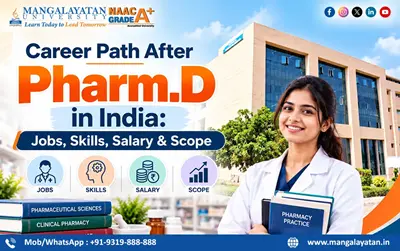
Pharm.D is a 6 years professionals master\'s course in pharmacy which was introduced with the objective to bring about concern for patient care and its measurement in pharmacy, pharmacology, and the study of drugs. After you complete the pharm d course, many related fields are available, such as hospitals, pharmaceuticals, clinical trials, healthcare services, and clinical services. Information about the career path after Pharm.D helps you decide whether to work or study.
What Can You Do After Pharm.D?
Following Pharm.D, one can find employment opportunities within clinical and pharmaceutical environments in which the knowledge of medicines and patient treatment procedures is useful. Some of these career opportunities include clinical pharmacy, hospital pharmacy, clinical research, pharmacovigilance, drug safety, and medical writing.
The Mangalayatan University claims that its Pharm.D. program includes subjects such as clinical research, pharmacotherapy, biostatistics and research methodologies, hospital pharmacy, clinical pharmacy and patient counselling techniques.
Career Options After Pharm.D in India
The main career options after Pharm.D include:
Job RoleMain Work Area
Clinical Pharmacist
Patient care and clinical pharmacy
Hospital Pharmacist
Hospital pharmacy services
Clinical Research Associate
Clinical research activities
Drug Safety Associate
Drug safety and safety data
Medical Writer
Medical and scientific content
Pharmacovigilance Professional
Medicine safety monitoring
Clinical Pharmacist
Clinical pharmacists are part of the health-care team and help deliver medication therapy management and other pharmaceutical services.
Read Also - Pharm D Course Details: Full Form, Eligibility, Fees, Admission, Top Colleges and Scope
Hospital Pharmacist
Hospital pharmacists help in the functions of the pharmacy in health care institutions and deal with drugs, prescriptions, and drug services.
Clinical Research Associate
Clinical research associates assist in clinical trials with activities that include documentation, coordination, monitoring, and research activities.
Drug Safety Associate
Drug safety associates deal with information regarding the safety of medicines and documentation of adverse events.
Medical Writer
A medical writer is an individual who produces medical and health care content for institutions, researchers, pharmaceutical companies, and other individuals.
Pharmacovigilance Professional
Pharmacovigilance professionals monitor and document information about the safety of medicines and pharmaceutical products.
Higher Studies After Pharm.D
The Graduates of Pharm.D. May opt for higher studies in the field of academics with regard to academics, research for those who want to make a career in Academic research. The options include specialisation, Postgraduate, Research and PhD, depending on eligibility.
There is also a PhD in Pharmacy offered at Mangalayatan University that focuses on clinical pharmacy, pharmacology, pharmaceutics and computer aided drug design.
Skills to Develop After Pharm.D
In addition to academic skills, graduates may enhance their employability by acquiring:
Clinical and pharmaceutical knowledge
Patient counselling and communication
Research methodology
Scientific documentation and writing
Data interpretation and analytical skills
Drug safety and pharmacovigilance knowledge
Teamwork and problem solving
Read Also - B.Pharm vs D.Pharm vs M.Pharm: Eligibility, Scope, Salary & Career Comparison
Pharm.D Salary and Career Growth in India
The Pharm.D salary in India varies according to the student\'s Job Position, Organisation, Location, experience, and Specialisation. Students could have a job position in a clinical, research or pharmaceutical field as their initial career and go on for specialisation later.
Career StageFactors Supporting Growth
Entry Level
Qualification and practical knowledge
Early Career
Experience and specialisation
Mid Career
Expertise and greater responsibilities
Senior Level
Leadership and specialised experience
There is no single fixed salary applicable to all Pharm.D graduates.
Begin your Career Journey with Pharmacy Program
Government and Private Jobs After Pharm.D
Government jobs after Pharm.D: You can get one in a research organisation, government organisations, or any other healthcare business, where the pharmacist Jobs, after completing the Pharm.D course, are signed up with the organisation, as well as can use the employment opportunity sent in the employment advertisement. The opportunities exist in both private and public sector organisations such as healthcare facilities, clinics, biotech firms, and so on.
Career Opportunities in Clinical and Pharmaceutical Fields
The Pharm.D graduate has the option to venture into careers in clinical pharmacy, hospitals, pharmaceuticals, clinical trials, drug safety, and medical writing. Specific career options as provided by Mangalayatan University include clinical pharmacist, drug safety and pharmacovigilance officer, clinical research associate, regulatory affairs specialist, and medical writer.
Read Also - D Pharma Course Details: Full Form, Admission, Eligibility, Entrance Exam, Fees, Colleges, Jobs
Why Choose Mangalayatan University for Pharm.D?
Pharm.D course at Mangalayatan University - a pharmacy professional program. The PG-Pharmacy program details given by Mangalayatan University state the Pharm.D 6-year program for 5 years academic year + 1 year internship comprised clinical pharmacy, hospital pharmacy, pharmacotherapeutics, clinical research and the other areas.
The School of Pharmacy of Mangalayatan University emphasises labs, faculty, research, conferences, and training. The pharmacy programs of the university claim to have been approved by the Pharmacy Council of India.
Conclusion
Career after Pharm.D include areas such as clinical pharmacy, hospitals, pharmaceutical industries, clinical trials and pharmacovigilance. There are various ways to enhance one’s career profile by gaining hands-on experience, having specialised skills and undergoing higher education. Selecting an area of career where your interest lies can help you develop specialisation in this field.