The media & communication sector is expanding fantastically in the modern world. This sector has seen impressive growth in a few industries recently, including broadcast, filmmaking, advertisement, print advertising, music, the internet, and many more. For people who are interested in a niche industry and wish to choose it as their career, journalism and mass communication course degrees provide a diverse range of chances for the next generation.
Therefore, this is the ideal time to join the media and entertainment profession. That sounds intriguing, right? Read the blog if the answer is yes!
Before deciding what would perform finest for you, a few of the most significant advantages have been described here.
What is Journalism and Mass Communication?
The study of mass media and communication has developed recently into a notion that impacts practically every facet of daily life and is only partially interactive. The study of journalism and mass communication is becoming more and more popular. This is due to the sheer number of media that has entered our lives through magazines, radio, and the internet.
What Exactly is Journalism and Mass Communication then?
Let us discuss this now!
Journalism is the process of obtaining, analysing, producing, and conveying news and information. It involves writing on recent events.
We learn about them, whether it is the most recent international news or information on the latest business trends around the world. Technology and the media are solely responsible for this. Hence, the study of disseminating information to an extensive audience via various forms of communication is known as mass communication.
Due to their depth of industry knowledge, journalism and mass communication course offer unrivalled academic and practical experience. In addition to fostering innate qualities of enthusiasm and creativity, the course framework aids in the creation and development of industry-oriented skill sets.
Before deciding let us take a quick look at some of the benefits of enrolling in this fascinating journalism and mass communication course.
Benefits of Pursuing Journalism and Mass Communication Degree
The benefits of this profession include social status, freedom to travel and experience different cultures, global networking, glam, creativity, and competency work. Having access to locations that are off-limits to most people also provides you with a distinctive outlook on the world.
For those who wants to see themselves separate from the throng, there are many prospects in journalism and mass communication. After all, in this sector, your creativity's uniqueness propels you to higher altitudes.
Listed below are Some Top 10 Benefits to help you understand:
1. Your communication skills will improve
A course in Journalism and Mass Communication requires you to express your thoughts, ideas and feeling in front of strangers or new people. When reporting or anchoring, a journalist is required to engage with new faces and speak fluently in their native tongue. You will interact with both media organisations and regular citizens while working in public relations, therefore you must be able to work well with others. To put it simply, this course helps you become a more assured media professional by increasing your vocabulary, boosting your confidence, and sharpening your communication abilities.
2. No previous experience is required
This course assists you in getting exposure without any prior experience. You get the freedom to work on different stories and it allows you to utilise their imaginative abilities. Along with your daily job responsibilities, there may be opportunities for you to travel, explore, and make money. You can even start as a newbie right after your graduation. Regardless of your background, this field is accessible to everyone who wants to change careers or begin a new one.
3. You can work on challenging and exciting projects
Studying media and journalism focuses on how society is changing and progressing. It is a field that offers both difficulties and excitement. It will allow you to interview famous personalities and celebrities.
While covering any news or events, you will be expected to broadcast live from the scene. Take local news coverage as an example; you will be required to be present where the event is happening. It is fascinating, but it is also challenging because you must report what you see. You must be proactive and finish assignments on schedule in this industry. At times, you might be able to dodge every obstacle, but such instances will teach you how to handle obstacles in the future.
4. Your power of creativity increases
Journalism and Mass communication is one among the many creative fields. You can develop your creative ability by pursuing a degree in journalism or mass communication. You learn the principles of aesthetics and how to apply them to your work. You learn how to employ artistic freedom and creativity to form your concepts and address problems.
For instance, if you are drafting an ad copy, you must utilise your imagination to come up with ingenious ideas, visuals and content. Additionally, this area is bursting with creative opportunities like photography, cinematography, and video editing, all of which require creativity. Therefore, to thrive, you must put up a lot of creative efforts.
5. Multiple career options
Having a wide range of abilities and information can help you succeed in this industry. Many individuals think that taking a journalism and mass communication education means you must work exclusively as a reporter or for a television network. The reality, however, is different.
Once you assess your interests, a wide selection of professional opportunities awaits. You can seek employment in publications like newspapers and magazines, radio stations, production companies, and public relations agencies to launch your career. For instance, if you want a career in advertising, you can create and develop ideas for companies to market their offerings and services. As an alternative, if you like to write, you might choose blogging or content writing.
6. Maintains an excellent social life
Journalism and mass communication, as the name implies, is a field that is highly concerned with societal advancement. Therefore, earning a degree in journalism or mass communication will not only enhance your social life but also give you tremendous power and influence over society.
As you will examine people, interview people, write about people and interact with a new community, the course, therefore, encourages you to be equipped for social situations. And everyone knows to be social, effective communication is the key component. In addition to teaching, your certain soft skills that will aid in maintaining excellent public relations, this course covers the fundamentals of public relations.
For instance, if you need to advertise your channel or want readers for your content, you need to be sociable. Therefore, mass communication will assist you in upholding positive interpersonal relationships, which would be beneficial in many facets of life. Overall, the course helps you become more socially adept.
7. Up to date with lots of news and applications
Fresh news reigns supreme in the media sector. Nowadays, most businesses want their workforce to have access to the most cutting-edge tools and technologies. Therefore, for the expansion of the company you are working at, you must stay updated, understand how to boost production and learn how to use the necessary tools.
Consider, if you work as a journalist, breaking news drives everything you do. Similarly, when writing news, you must be knowledgeable about both the intricacies of your subject and global current events. Additionally, due to digitalization, those that have a solid understanding of emerging advancements will be able to reach their intended audience and thrive.
8. Various Subjects for Study and Profession
Several dual honours degrees in media studies are typically available, allowing you to advance your study of two different academic disciplines or blend a cultural education with another of your interests. It is irrelevant that you cannot pursue another specialization or career path while studying journalism and mass communication. Instead, this sector opens you a wide range of options for your future research or professional growth. You might switch to writing, filmmaking, photography, or even video editing.
As a result, you can opt for any profession you aspire. You can launch your own business, work as a public relations specialist, a writer, and many other professions. Therefore, taking a journalism and mass communication course will benefit both your career and personal development.
9. Plentiful practical exposure and adventure
BJMC admission is indeed the right fields for you if you do not want to have a 9 to 5 job but want some excitement and adventure in your line of work. With the help of this course, students will be able to travel various destinations, see the realm from the standpoint of a reporter or filmmaker and cover a variety of stories and events. Additionally, it allows the student the liberty to exercise all their creative capabilities. In this field, no working method allows the learner the opportunity to experiment and develop their working style.
For instance, if you want to be a journalist, you must be adaptable to cover breaking events as soon as feasible. Unlike 9 to 5 clerical jobs, you will have to travel and investigate a lot.
10. Power and Fame
According to the proverb, "The Pen is mightier than the Sword," a journalist can persuade a sizable audience with his ideas and innovative writing style. As a dynamic journalist, you may serve as the people's voice and can direct billions of individuals at once.
Next in the row is “fame.” People aspire to be famous. Various glam and glittery events serve as a gateway to celebs, leaders, and others. Meeting renowned and well-known people is a possibility if you pursue a journalism and mass communication degree.
11. Income
Media professionals hold excellent jobs with competitive salaries. Opportunities like freelancing in media and communication can help newcomers advance quickly. There are more opportunities for job advancement due to the rising need for social media managers.
A variety of professions, including news anchor, columnist, media analyst, radio jockey, social media manager, and public relations officer, may provide students with lucrative career opportunities and decent remuneration.
Enhance Your Career Growth with a Journalism and Mass Communication Program
Conclusion
In the eyes of the media, the world is a blank canvas that can be painted in any colour using modern tools. The best motivation to pursue journalism and mass communication is the ease with which our lives are organised into several engagements. A degree in journalism or mass communication gives you the chance to work for or with imaginative, intelligent people who motivate you to succeed.
There are constantly job openings in the sphere of mass media, which is expanding. While working, one experiences recognition, glory, and prosperity, as well as travel.
Therefore, we cordially invite you to Mangalayatan University in Aligarh to take part in cutting-edge education with world-class amenities.
ADMISSION OPEN
Unlock Your Potential with World-Class Education
Choose from diverse programs designed to prepare you for global opportunities. Your future begins here.
The career path after PGDBM in India can provide scope in the fields of business management, marketing, finance, human resources and strategic management. On completing PGDBM course, students can find work as they clear the exam or can go for higher studies.
PGDBM programme encourages students to grow managerial, analytical, and decision-making abilities to make a career in several sectors of business and management.
What Can You Do After PGDBM?
Job Opportunities after PGDBM Business Development, marketing, HR, Operations, Sales & Consulting jobs are available for PGDBM graduates. The PGDBM career scope also include finance, entrepreneurship, project management and other business areas.
Depending on the specialisation, work experience, communication skill and interest of the candidate, they can look for wide range of career options after PGDBM.
Career Options After PGDBM in India
Some common jobs after PGDBM include:
Job RoleKey Responsibility
Business Development Manager
Identify opportunities and develop business relationships
Marketing Executive
Plan and support marketing activities
Human Resources Executive
Manage recruitment and employee-related functions
Operations Executive
Coordinate processes and business operations
Sales Manager
Manage sales activities and customer relationships
Management Consultant
Analyse business challenges and suggest solutions
Business Development Manager
As a business development manager, you\'ll identify future markets and business partners. You will establish and develop business relationships and take a new business to the next level. Strong communication, negotiation and market research skills will be necessary.
Marketing Executive
Marketing executives are responsible for campaigns, market research, customer engagement and promotional activities. An understanding of consumer behaviour, branding and digital marketing can help students open up various PGDBM career opportunities.
Human Resources Executive
HR executives help recruit new employees, manage their orientation, and ensure they are engaged with the workplace, managing training and personnel administration. Good people skills and effective communication ability are essential for a career in this field.
Operations Executive
Operations executives oversee the daily running of the organisation in terms of management of people, resources and processes. This role could be of interest to those who graduate with an interest in operations, logistics and organisation.
Sales Manager
Sales managers manage their team as well as take charge of sales activities and customer relations. They can analyse market trends and prepare sales targets and strategies to bring in growth in the business.
Management Consultant
Management consultants study organisational problems and develop solutions as they work through areas of strategy, operations, marketing or other aspects of the business. They use analytical thinking and have strong communication and problem solving skills.
Higher Studies After PGDBM
Higher education options for PGDBM students: A student can go for an MBA or other high-end, specific management courses to further their expertise in the domain. Common specialisations are finance, marketing, business analytics, HR management and operations.
PGDBM business management course students can pursue certifications in the relevant industry domain. Your choice of higher studies after PGDBM will be influenced by your career goals, interests, and your domain to work in.
Skills to Develop After PGDBM
To strengthen PGDBM career opportunities, students should develop:
Communication and presentation skills
Leadership and team management
Business and analytical thinking
Problem-solving and decision-making
Data interpretation
Digital and technology skills
Negotiation and time management
Career Advancement Cell: Communicative skills, presentation skills, leadership qualities, team management skills, time management skills, interview skills and other employability skills are given importance in the Career Advancement Cell of Mangalayatan University.
PGDBM Salary and Career Growth in India
PGDBM salary in India also varies based on various parameters like job profile, organisation, industry, location, skills and experience. PGDBM graduates, after completing the course, can get into sales, marketing, HR, operations and business development as a fresher.
With years of experience and acquired specialisation, the PGDBM Candidates can get the opportunity of working as a senior executive, manager, expert and leader in various industries.
Government and Private Jobs After PGDBM
There are a lot of government jobs after PGDBM that can be available through competitive exams and recruitment, but it depends on the eligibility criteria of the positions. The private jobs after PGDBM include jobs in areas of marketing, sales, HR, finance, operations, business development and consulting. Opportunities in various industries depend on the student\'s skills, qualifications, experience and the organisation\'s needs.
Career Opportunities in Business Management
PGDBM Career Opportunities – After PGDBM career scope is marketing, human resources, finance, sales and business development, and operations. You may opt for the ones which fit your interests and strengths.
The scope of career after PGDBM as as per Mangalayatan University are as a Business Development Manager, as a Marketing Manager, as a Human Resource Manager and many more options are there for students in the field of business management.
Why Choose Mangalayatan University for PGDBM?
Mangalayatan University Aligarh offered a 2-year PGDBM programme spread over 4 semesters. The programme introduces students to different areas of managerial practice, including marketing management, financial management, human resource management, business communication, operations management, strategic management and business law. Mangalayatan University PGDBM programme also features case studies, participative learning and real-life applications to enhance managerial and hands-on competencies.
Masters in Business Administration (MBA) Career Advancement initiative at the university can involve developing soft skills, communication and presentations skills, interviewing and team building skills.
Conclusion
The career path after PGDBM in India can span across various business and managerial roles. A PGDBM graduate can start at an executive level, and acquire skills to move towards managerial roles with a specialised skill set. Creating effective communication, analysis and problem solving skills, and building managerial qualities can enable PGDBM professionals to meet dynamic business demands.?
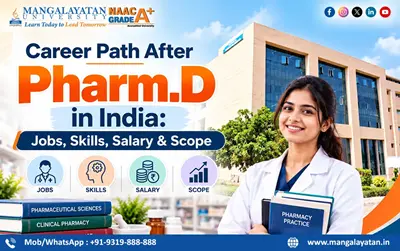
Pharm.D is a 6 years professionals master\'s course in pharmacy which was introduced with the objective to bring about concern for patient care and its measurement in pharmacy, pharmacology, and the study of drugs. After you complete the pharm d course, many related fields are available, such as hospitals, pharmaceuticals, clinical trials, healthcare services, and clinical services. Information about the career path after Pharm.D helps you decide whether to work or study.
What Can You Do After Pharm.D?
Following Pharm.D, one can find employment opportunities within clinical and pharmaceutical environments in which the knowledge of medicines and patient treatment procedures is useful. Some of these career opportunities include clinical pharmacy, hospital pharmacy, clinical research, pharmacovigilance, drug safety, and medical writing.
The Mangalayatan University claims that its Pharm.D. program includes subjects such as clinical research, pharmacotherapy, biostatistics and research methodologies, hospital pharmacy, clinical pharmacy and patient counselling techniques.
Career Options After Pharm.D in India
The main career options after Pharm.D include:
Job RoleMain Work Area
Clinical Pharmacist
Patient care and clinical pharmacy
Hospital Pharmacist
Hospital pharmacy services
Clinical Research Associate
Clinical research activities
Drug Safety Associate
Drug safety and safety data
Medical Writer
Medical and scientific content
Pharmacovigilance Professional
Medicine safety monitoring
Clinical Pharmacist
Clinical pharmacists are part of the health-care team and help deliver medication therapy management and other pharmaceutical services.
Read Also - Pharm D Course Details: Full Form, Eligibility, Fees, Admission, Top Colleges and Scope
Hospital Pharmacist
Hospital pharmacists help in the functions of the pharmacy in health care institutions and deal with drugs, prescriptions, and drug services.
Clinical Research Associate
Clinical research associates assist in clinical trials with activities that include documentation, coordination, monitoring, and research activities.
Drug Safety Associate
Drug safety associates deal with information regarding the safety of medicines and documentation of adverse events.
Medical Writer
A medical writer is an individual who produces medical and health care content for institutions, researchers, pharmaceutical companies, and other individuals.
Pharmacovigilance Professional
Pharmacovigilance professionals monitor and document information about the safety of medicines and pharmaceutical products.
Higher Studies After Pharm.D
The Graduates of Pharm.D. May opt for higher studies in the field of academics with regard to academics, research for those who want to make a career in Academic research. The options include specialisation, Postgraduate, Research and PhD, depending on eligibility.
There is also a PhD in Pharmacy offered at Mangalayatan University that focuses on clinical pharmacy, pharmacology, pharmaceutics and computer aided drug design.
Skills to Develop After Pharm.D
In addition to academic skills, graduates may enhance their employability by acquiring:
Clinical and pharmaceutical knowledge
Patient counselling and communication
Research methodology
Scientific documentation and writing
Data interpretation and analytical skills
Drug safety and pharmacovigilance knowledge
Teamwork and problem solving
Read Also - B.Pharm vs D.Pharm vs M.Pharm: Eligibility, Scope, Salary & Career Comparison
Pharm.D Salary and Career Growth in India
The Pharm.D salary in India varies according to the student\'s Job Position, Organisation, Location, experience, and Specialisation. Students could have a job position in a clinical, research or pharmaceutical field as their initial career and go on for specialisation later.
Career StageFactors Supporting Growth
Entry Level
Qualification and practical knowledge
Early Career
Experience and specialisation
Mid Career
Expertise and greater responsibilities
Senior Level
Leadership and specialised experience
There is no single fixed salary applicable to all Pharm.D graduates.
Begin your Career Journey with Pharmacy Program
Government and Private Jobs After Pharm.D
Government jobs after Pharm.D: You can get one in a research organisation, government organisations, or any other healthcare business, where the pharmacist Jobs, after completing the Pharm.D course, are signed up with the organisation, as well as can use the employment opportunity sent in the employment advertisement. The opportunities exist in both private and public sector organisations such as healthcare facilities, clinics, biotech firms, and so on.
Career Opportunities in Clinical and Pharmaceutical Fields
The Pharm.D graduate has the option to venture into careers in clinical pharmacy, hospitals, pharmaceuticals, clinical trials, drug safety, and medical writing. Specific career options as provided by Mangalayatan University include clinical pharmacist, drug safety and pharmacovigilance officer, clinical research associate, regulatory affairs specialist, and medical writer.
Read Also - D Pharma Course Details: Full Form, Admission, Eligibility, Entrance Exam, Fees, Colleges, Jobs
Why Choose Mangalayatan University for Pharm.D?
Pharm.D course at Mangalayatan University - a pharmacy professional program. The PG-Pharmacy program details given by Mangalayatan University state the Pharm.D 6-year program for 5 years academic year + 1 year internship comprised clinical pharmacy, hospital pharmacy, pharmacotherapeutics, clinical research and the other areas.
The School of Pharmacy of Mangalayatan University emphasises labs, faculty, research, conferences, and training. The pharmacy programs of the university claim to have been approved by the Pharmacy Council of India.
Conclusion
Career after Pharm.D include areas such as clinical pharmacy, hospitals, pharmaceutical industries, clinical trials and pharmacovigilance. There are various ways to enhance one’s career profile by gaining hands-on experience, having specialised skills and undergoing higher education. Selecting an area of career where your interest lies can help you develop specialisation in this field.
Choosing the right postgraduate degree can define your career trajectory in the technology (IT) industry. Two of the most sought-after degrees in India are the Master of Technology in Computer Science and Engineering (MTech CSE) and the Master of Computer Applications (MCA). Both pathways unlock lucrative opportunities in software, data science, and IT management, yet they serve distinct academic and professional purposes.
At Mangalayatan University, both MTech CSE and MCA programs are designed to empower students with industry-relevant skills, modern lab infrastructure, and active placement support. This guide breaks down both options to help you determine which program aligns best with your background and goals.
Read Also - MCA Course Admission: Top College, Full Form, Duration, Details, Benefits, Salary, Scope, Fees, Eligibility, Syllabus, Entry Exam, and More
What Is the Difference Between MTech CSE and MCA?
The primary difference between MTech CSE and MCA lies in their core focus: engineering theory and core computation versus practical software application.
Comparison FactorMTech CSEMCA
Full form
Master of Technology in Computer Science and Engineering
Master of Computer Applications
Degree type
Postgraduate engineering degree
Postgraduate computer applications degree
Main focus
Computing theory, algorithm design, system architecture, and cutting-edge technical research
Software development, application programming, and business IT management
Learning approach
Advanced technical study, engineering problem-solving, and research where included in the curriculum
Application-oriented learning, software projects, and practical computing
Common subject areas
Advanced algorithms, AI/ML, computer networks, system architecture
Programming, web technologies, DBMS, software engineering
Core Skills & Outcomes
Builds great technical problem-solving skills for complex infrastructure, hardware-software integration, and technological innovations.
Bridges computer applications with real-world business requirements, preparing students to design, develop, test, and deploy software applications across enterprise environments.
Potential career paths
Specialised software engineering, systems engineering, research, and technical roles
Software development, application development, database management, and IT services
Duration
2 years, subject to programme regulations
2 years, subject to programme regulations
At Mangalayatan University, both programs reflect these core philosophies. MTech CSE focuses on research methodologies and advanced system design, while MCA focuses on full-stack application development and contemporary software solutions.
MTech CSE vs MCA: Eligibility, Duration and Admission Process
Understanding the entry prerequisites and timeline ensures you select a program that fits your educational background.
CriteriaMTech CSEMCA
Duration
2 Years (4 Semesters)
2 Years (4 Semesters)
Eligibility
B.E. / B.Tech in CSE or relevant engineering field (or MCA/M.Sc. CS) with min. 50% marks.
BCA, B.Sc. (CS/IT), or graduation with Mathematics at 10+2 or degree level with min. 50% marks.
Admission Basis
Merit-based / Entrance exams (e.g., GATE). Direct admission available at Mangalayatan University.
Merit-based / State or National tests (e.g., NIMCET, CUET-PG). Direct merit admission offered at Mangalayatan University.
Mangalayatan University streamlines the admission process for both programs through transparent merit-based criteria and direct entry pathways, making higher technical education accessible to deserving graduates.
Read Also - MTech CSE Course Details: Full Form, Admission, Eligibility, Entrance Exam, Fees, and Colleges
MTech CSE vs MCA: Syllabus and Subjects
The curriculum design at Mangalayatan University ensures that students receive hands-on training tailored to modern IT demands.
MTech CSE Curriculum Focus:
Advanced Data Structures & Complex Algorithms
Artificial Intelligence, Machine Learning & Deep Learning
Cloud Infrastructure & Big Data Analytics
Cybersecurity, System Architecture, & IoT
Thesis Work, Technical Research, & Seminars
MCA Curriculum Focus:
Core Programming Languages (C, C++, Java, Python)
Web Technologies & Full-Stack Development
Database Management Systems (DBMS) & Data Analytics
Software Engineering, Testing, & Quality Assurance
Industry Projects, Mini Projects, & Internships
While MTech CSE candidates work extensively on algorithmic efficiency and theoretical experimentation, MCA candidates build commercial software products, enterprise databases, and mobile/web applications.
Career Prospects, Top Job Roles, and Salary Comparison
Here is the comparison table created from your text content:
Comparison AspectMTech CSEMCA
Key Job Roles
System Architect, Data Scientist, R&D Engineer, AI/ML Specialist, Cloud Engineer, Systems Analyst, Academic/Research positions
Software Developer, Full-Stack Developer, Web/App Developer, Database Administrator, QA/Software Tester, IT Project Manager
Target Industries
Tech R&D centers, cloud architecture labs, high-frequency computing firms, defense technology, higher education institutions
IT services firms, software product companies, e-commerce platforms, fintech, digital consultancies
Average Starting Salary
INR 5 to 10+ LPA (especially for specialized roles like AI/ML or Cloud Systems Engineering)
INR 4 to 8 LPA (for entry roles like Software or Full-Stack Developer, growing rapidly with experience)
Placement Support at Mangalayatan University
Active Training & Placement Cell collaborating with 120+ top corporate recruiters offering placement drives, internships, and career counseling
Active Training & Placement Cell collaborating with 120+ top corporate recruiters offering placement drives, internships, and career counseling
MTech CSE vs MCA: Which Course Is Better for Your Career Goals?
Choosing between MTech CSE and MCA comes down to your academic background, core interests, and career ambitions.
Read Also - List of Best Engineering Colleges after 12th in Aligarh, Uttar Pradesh
Choose MTech CSE or MCA at Mangalayatan University if:
Both MTech CSE and MCA are perpetually lucrative career options to pursue at Mangalayatan University. With B.Tech graduates, M.Tech is the higher education option, whereas BCA graduates can opt for MCA. The curriculum is more or less the same, and the aspirants gain knowledge and technical know-how about computer applications and programming, along with hardware and software learning and management.
The Verdict: Your Gateway to IT Success at Mangalayatan University
Whether your passion lies in high-level engineering systems or rapid software execution, both paths lead to high-impact technology careers. If your primary ambition is to break into the fast-paced software development industry—building hands-on applications, designing web solutions, managing enterprise databases, or securing key IT service roles—MCA offers the ideal practical springboard. On the other hand, if you aim to master core computing architectures and theoretical innovation, MTech CSE equips you to drive next-generation engineering research.
At Mangalayatan University, you don\'t have to navigate this journey alone. With UGC and AICTE approvals, world-class faculty, state-of-the-art computing labs, and an affordable fee structure, Mangalayatan University provides the supportive ecosystem every aspiring tech professional needs to turn ambition into a thriving reality.
Frequently Asked Questions (FAQs)
Which is better, MTech CSE or MCA?
M.Tech CSE is preferred by aspirant who want to learn advanced computing, specialized engineering and research, where as aspirants do MCA , inclined towards programming, software development and computer applications. Nevertheless, the best choice is where your career aspiration aligns with your educational qualifications.
Which has a higher salary, MTech CSE or MCA?
Eventually, Salary is dependent upon your technical know-how and how you perform at thew and on your service tenure with the organization.
What is the difference between MTech CSE and MCA?
M.Tech CSE focuses on engineering concepts, advanced computer science, and technical specialization, whereas MCA focuses on programming, databases, computer applications and software development.
Which course is better after BCA, MCA or MTech CSE?
MCA is a master level programme after BCA where as for M.Tech CSE you need to have a B.Tech CSE.
What are the career options after MTech CSE and MCA?
Both the qualifications M.Tech CSE and MCA holds a bright future in the field of Information Communication and Technology (ICT) .It depends on your technical skill and organizational demands.
What are trending concepts taught in M.Tech CSE or MCA?
Both the programmes include some of the some of the trending concepts like full-stack development, software development, database administration, software testing, and IT services.