BPT admission has shown its prominence in the paramedical industry and usually focuses on the rehabilitation and physical therapy of patients. The BPT degree program can be completed in four years, and during the course tenure, the student undergoes theoretical learning and practical training as well. The BPT course duration is structured with a vast and varied curriculum; concepts like biomechanics, pharmacology, physiology, anatomy, and various physical therapy techniques are taught. The course offers career opportunities after completion, such as physiotherapists in clinics, rehabilitation centres, hospitals, or sports facilities. Students can also pursue higher studies in physiotherapy and research.
BPT Full Form
BPT stands for Bachelor of Physiotherapy. It is a 4.5 year undergraduate degree program that focused on physiotherapy and rehabilitation science.
BPT Admission Eligibility Criteria after 12th
Admission to Bachelor of Physiotherapy courses in India involves the following. It is also to note that different universities and colleges vary in their selection process.
Eligibility Criteria: Candidates must have completed 10+2 or equivalent with Physics, Chemistry, and Biology as core subjects with a minimum 50% aggregate percentage.
Entrance Exams: For admission in BPT courses, one may have to take NEET (National Eligibility cum Entrance Test) or state-level CETs (Common Entrance Tests), which is state-based.
Application Process: Interested candidates need to fill out application forms available on the respective university's or college's website. Application forms usually require personal details, educational background, and other relevant information.
Selection Criteria: The selection of the candidates is purely based on the marks obtained in the entrance examination or some colleges and universities take direct admission based on the marks obtained at the 10+2 level.?
Counselling Process: The counselling process is conducted for those students who qualify in the entrance examination and are allowed to choose their preferred college based on the marks obtained in the entrance exam and the availability of seats.
Top 6 Private BPT Colleges in Delhi NCR, Uttar Pradesh, India
The BPT course has the most promising career prospects, as Graduates can work in various sectors, including healthcare facilities, sports organizations, and fitness centres, or even start their own practice. Some of the best BPT colleges are mentioned below:
Mangalayatan University, Aligarh is known for offering well well-rounded BPT course with all the modern infrastructural facilities and industry collaboration at the University.
Sharda University, Greater Noida: Offers a well-rounded program with modern facilities and strong industry connections.
Career Institute of Medical Sciences & Hospital, Lucknow: Renowned for its focus on practical training and clinical exposure.
Saraswati Group of Institutions, Ghaziabad: Offers a rigorous curriculum with emphasis on both theoretical knowledge and practical skills.
Santosh Medical College and Hospital, Ghaziabad: Known for its comprehensive medical facilities and experienced faculty.
IIMT University, Meerut: Known for its integrated approach to medical education and modern infrastructure.
When considering BPT colleges, it's essential to research each institution thoroughly, visit if possible, and consider factors such as accreditation, faculty qualifications, placement records, and student reviews to make an informed decision.
Bachelor of Physiotherapy Course Details in India
Full Form
Bachelor of Physiotherapy Course
Course Level
Bachelor’s
Course Duration
4 years
Eligibility
candidates must have completed 10+2 or equivalent with PCB
Course Fee
INR 90,000 - 1 LPA
Examination Type
Semester and Annual
Admission Process
Merit Based, Entrance-Based
Average Salary After Degree
INR 6 LPA (Pay Scale)
Recruiting Companies After Degree
Apollo Hospital, Hosmat hospital, Medanta , Max, AIIMS, Fortis Hospital
BPT Admission Fee Structure:
The fee structure for BPT (Bachelor of Physiotherapy) courses can vary depending on the college or university. Here's a general overview based on typical patterns. Bachelor of Physiotherapy course are highly cost-effective and the fee structure design can vary from INR 50,000 to 3,00,000 per year. The institutes charge additional fees such as library fees, examination fees or laboratory fees and other miscellaneous fees. Different universities/colleges have different fee structure.
BPT Course Duration after 12th
The Bachelor of Physiotherapy course is a four-year with eight-semester degree program.
Bachelor of Physiotherapy Course Syllabus:
Here is an overview of the core courses students can expect from the first to the eighth semester in a BPT program are below
BPT 1st Year Syllabus
BPT 2nd Year Syllabus
Physiology
Pathology
Psychology
Pharmacology
Biochemistry
Microbiology
Basics of Nursing
Exercise Therapy
English and Communication Skills
Biomechanics
Anatomy
Electrotherapy
BPT 3rd Year Syllabus
BPT 4th Year Syllabus
Medicine
Physical Rehabilitation
Orthopedics
Neurological Physiotherapy
Surgery
Sports Physiotherapy
General Medicine
Pediatrics and Geriatrics Physiotherapy
Community Medicine
Cardiovascular and Respiratory Physiotherapy
General Surgery
-
Internship/ Clinical Training: These trainings are of 6 months and during the training, the student gets exposure to real-life patient problems and provides solutions to those.
Begin your Medical Journey in BPT Program
Top 10 Career Opportunities after BPT Degree Course in India
Clinical Practice: Clinical practice such as working in hospitals, rehabilitation centres etc. BPT graduates identify patients' physical conditions, treatment plans, recovery process and manage chronic conditions.
Sports Rehabilitation: Sports Rehabilitation is a trending job prospect for Physiotherapists graduates as it helps patients recover from sports injuries improve performance, and prevent future problems.
Pediatric and Geriatric Care: BPT graduates may specialize in treating children (pediatrics) or elderly patients (geriatrics), focusing on conditions specific to these age groups.
Orthopaedic Physiotherapy: Treating musculoskeletal conditions and injuries viz fractures, arthritis, joint replacements etc. are taken care of.
Neurological Physiotherapy: Neurological disorders are also taken care viz., multiple sclerosis, Parkinson's disease, spinal cord injuries and stroke.
Cardiopulmonary Physiotherapy: Helping patients recover from heart and lung conditions through exercises and breathing techniques.
Academic and Research: Some graduates opt for further studies (like Master's or PhD) and pursue careers in teaching and research in universities or research institutions.
Sports Medicine Clinics: Working with sports medicine physicians and orthopedic surgeons to provide specialized care to athletes.
Healthcare Administration: BPT graduates can also move into administrative roles within healthcare settings, managing departments or facilities.
Entrepreneurship: Setting up private physiotherapy clinics or consultancy services is also a viable option for entrepreneurial-minded graduates.
Overall, the demand for physiotherapists in India is growing, driven by an ageing population, increased awareness of fitness and wellness, and advancements in medical treatments requiring rehabilitation services. Graduates need to stay updated with advancements in their field through continuing education and training to enhance their career prospects.
BPT: Related FAQs
Q1 - What is the full form of BPT
BPT stands for Bachelor of Physiotherapy. This healthcare undergraduate program prepares students to become licensed physiotherapists by giving them the theoretical and practical skills necessary to evaluate, diagnose, and treat a range of physical ailments and movement abnormalities in patients.
Q2 - What is the duration of the BPT course in India?
In India, a Bachelor of Physiotherapy (BPT) program typically lasts 4.5 years, consisting of four years of coursework plus a required six-month internship. Students study the theoretical and practical facets of physiotherapy during their academic years, and they gain practical clinical experience during their internship.
Q3 - What are the eligibility criteria for BPT admission?
You must have completed 10+2 (Class 12) with Physics, Chemistry, and Biology (PCB) as core subjects from an accredited board, usually with a minimum of 50% aggregate marks, in order to be eligible for a Bachelor of Physiotherapy (BPT) degree. Although some universities provide merit-based admission, you must be at least 17 years old and may need to pass state-level or national entrance tests like the CUET or NEET.
Q4 - Is NEET required for BPT admission?
No, not all BPT (Bachelor of Physiotherapy) admissions require NEET; however, as a result of an upgrade from the National Council for Allied Health Sciences (NCAHP), several universities will begin requiring it in 2025. NEET is now a requirement for a substantial portion of BPT programs, so you should confirm the exact requirements of the colleges you are interested in, even though some still admit students based on their own admission exams or Class 12 merit.
Q5 - What is the average fee for a BPT course in India?
Top-tier private universities can charge much higher fees, ranging from INR 5 Lakhs to over ?10 Lakhs annually, while government and many private colleges typically charge between INR 25,000 and INR 3.5 Lakhs for a BPT (Bachelor of Physiotherapy) course. The whole cost, which may also include extra costs for tests and study materials, is influenced by elements such as the college's reputation, location, and amenities.
Q6 - What subjects are covered in the BPT syllabus?
In addition to core physiotherapy disciplines like kinesiology, exercise therapy, and electrotherapy, the BPT syllabus covers basic medical subjects including human anatomy, physiology, and biochemistry. It also covers several specialty areas, such as orthopaedics, neurology, and cardiopulmonary physiotherapy. To prepare students for professional practice, the program also incorporates practical elements like as research methodology, biostatistics, ethics, and a required clinical internship.
Q7 - Is an internship compulsory in the BPT program?
Yes, in order to obtain real-world experience in clinical settings, the Bachelor of Physiotherapy (BPT) program needs an internship. Usually lasting six months to a year, the internship enables students to put their academic knowledge to use in hospitals and rehabilitation facilities while being supervised by seasoned specialists.
Q8 - What is the average salary after completing a BPT degree?
In India, fresh graduates with a BPT degree typically earn between INR 2.5 and 3 lakhs annually; with experience and specialization, this amount can rise to INR 5 to 6 lakhs or more. Factors including job experience, location, type of employer (government vs. private), and specialty considerably influence income potential, with experienced and specialized physiotherapists in private practices or senior posts earning substantially more.
Q9 - What are the career opportunities after BPT?
You can work as a physiotherapist in clinics, hospitals, and sports facilities after earning a Bachelor of Physiotherapy (BPT). You can also specialize in neurological, pediatric, or sports physiotherapy. Other options include beginning a private practice or working as an ergonomic specialist, researcher, or instructor. Additionally, you can work with NGOs and community health or pursue additional education.
Q10 - Why should I choose Mangalayatan University, Aligarh, for BPT admission?
Mangalayatan University emphasises practical, hands-on physiotherapy education, state-of-the-art facilities, including well-equipped labs, a dedicated placement cell, knowledgeable professors, and NAAC accreditation. Mangalayatan University, Aligarh, is the best choice for your BPT enrollment. With internships and business partnerships, the institution takes a student-centred approach to make sure graduates are ready for lucrative opportunities in the physiotherapy field.
ADMISSION OPEN
Unlock Your Potential with World-Class Education
Choose from diverse programs designed to prepare you for global opportunities. Your future begins here.
The career path after PGDBM in India can provide scope in the fields of business management, marketing, finance, human resources and strategic management. On completing PGDBM course, students can find work as they clear the exam or can go for higher studies.
PGDBM programme encourages students to grow managerial, analytical, and decision-making abilities to make a career in several sectors of business and management.
What Can You Do After PGDBM?
Job Opportunities after PGDBM Business Development, marketing, HR, Operations, Sales & Consulting jobs are available for PGDBM graduates. The PGDBM career scope also include finance, entrepreneurship, project management and other business areas.
Depending on the specialisation, work experience, communication skill and interest of the candidate, they can look for wide range of career options after PGDBM.
Career Options After PGDBM in India
Some common jobs after PGDBM include:
Job RoleKey Responsibility
Business Development Manager
Identify opportunities and develop business relationships
Marketing Executive
Plan and support marketing activities
Human Resources Executive
Manage recruitment and employee-related functions
Operations Executive
Coordinate processes and business operations
Sales Manager
Manage sales activities and customer relationships
Management Consultant
Analyse business challenges and suggest solutions
Business Development Manager
As a business development manager, you\'ll identify future markets and business partners. You will establish and develop business relationships and take a new business to the next level. Strong communication, negotiation and market research skills will be necessary.
Marketing Executive
Marketing executives are responsible for campaigns, market research, customer engagement and promotional activities. An understanding of consumer behaviour, branding and digital marketing can help students open up various PGDBM career opportunities.
Human Resources Executive
HR executives help recruit new employees, manage their orientation, and ensure they are engaged with the workplace, managing training and personnel administration. Good people skills and effective communication ability are essential for a career in this field.
Operations Executive
Operations executives oversee the daily running of the organisation in terms of management of people, resources and processes. This role could be of interest to those who graduate with an interest in operations, logistics and organisation.
Sales Manager
Sales managers manage their team as well as take charge of sales activities and customer relations. They can analyse market trends and prepare sales targets and strategies to bring in growth in the business.
Management Consultant
Management consultants study organisational problems and develop solutions as they work through areas of strategy, operations, marketing or other aspects of the business. They use analytical thinking and have strong communication and problem solving skills.
Higher Studies After PGDBM
Higher education options for PGDBM students: A student can go for an MBA or other high-end, specific management courses to further their expertise in the domain. Common specialisations are finance, marketing, business analytics, HR management and operations.
PGDBM business management course students can pursue certifications in the relevant industry domain. Your choice of higher studies after PGDBM will be influenced by your career goals, interests, and your domain to work in.
Skills to Develop After PGDBM
To strengthen PGDBM career opportunities, students should develop:
Communication and presentation skills
Leadership and team management
Business and analytical thinking
Problem-solving and decision-making
Data interpretation
Digital and technology skills
Negotiation and time management
Career Advancement Cell: Communicative skills, presentation skills, leadership qualities, team management skills, time management skills, interview skills and other employability skills are given importance in the Career Advancement Cell of Mangalayatan University.
PGDBM Salary and Career Growth in India
PGDBM salary in India also varies based on various parameters like job profile, organisation, industry, location, skills and experience. PGDBM graduates, after completing the course, can get into sales, marketing, HR, operations and business development as a fresher.
With years of experience and acquired specialisation, the PGDBM Candidates can get the opportunity of working as a senior executive, manager, expert and leader in various industries.
Government and Private Jobs After PGDBM
There are a lot of government jobs after PGDBM that can be available through competitive exams and recruitment, but it depends on the eligibility criteria of the positions. The private jobs after PGDBM include jobs in areas of marketing, sales, HR, finance, operations, business development and consulting. Opportunities in various industries depend on the student\'s skills, qualifications, experience and the organisation\'s needs.
Career Opportunities in Business Management
PGDBM Career Opportunities – After PGDBM career scope is marketing, human resources, finance, sales and business development, and operations. You may opt for the ones which fit your interests and strengths.
The scope of career after PGDBM as as per Mangalayatan University are as a Business Development Manager, as a Marketing Manager, as a Human Resource Manager and many more options are there for students in the field of business management.
Why Choose Mangalayatan University for PGDBM?
Mangalayatan University Aligarh offered a 2-year PGDBM programme spread over 4 semesters. The programme introduces students to different areas of managerial practice, including marketing management, financial management, human resource management, business communication, operations management, strategic management and business law. Mangalayatan University PGDBM programme also features case studies, participative learning and real-life applications to enhance managerial and hands-on competencies.
Masters in Business Administration (MBA) Career Advancement initiative at the university can involve developing soft skills, communication and presentations skills, interviewing and team building skills.
Conclusion
The career path after PGDBM in India can span across various business and managerial roles. A PGDBM graduate can start at an executive level, and acquire skills to move towards managerial roles with a specialised skill set. Creating effective communication, analysis and problem solving skills, and building managerial qualities can enable PGDBM professionals to meet dynamic business demands.?
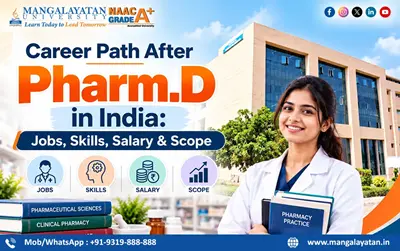
Pharm.D is a 6 years professionals master\'s course in pharmacy which was introduced with the objective to bring about concern for patient care and its measurement in pharmacy, pharmacology, and the study of drugs. After you complete the pharm d course, many related fields are available, such as hospitals, pharmaceuticals, clinical trials, healthcare services, and clinical services. Information about the career path after Pharm.D helps you decide whether to work or study.
What Can You Do After Pharm.D?
Following Pharm.D, one can find employment opportunities within clinical and pharmaceutical environments in which the knowledge of medicines and patient treatment procedures is useful. Some of these career opportunities include clinical pharmacy, hospital pharmacy, clinical research, pharmacovigilance, drug safety, and medical writing.
The Mangalayatan University claims that its Pharm.D. program includes subjects such as clinical research, pharmacotherapy, biostatistics and research methodologies, hospital pharmacy, clinical pharmacy and patient counselling techniques.
Career Options After Pharm.D in India
The main career options after Pharm.D include:
Job RoleMain Work Area
Clinical Pharmacist
Patient care and clinical pharmacy
Hospital Pharmacist
Hospital pharmacy services
Clinical Research Associate
Clinical research activities
Drug Safety Associate
Drug safety and safety data
Medical Writer
Medical and scientific content
Pharmacovigilance Professional
Medicine safety monitoring
Clinical Pharmacist
Clinical pharmacists are part of the health-care team and help deliver medication therapy management and other pharmaceutical services.
Read Also - Pharm D Course Details: Full Form, Eligibility, Fees, Admission, Top Colleges and Scope
Hospital Pharmacist
Hospital pharmacists help in the functions of the pharmacy in health care institutions and deal with drugs, prescriptions, and drug services.
Clinical Research Associate
Clinical research associates assist in clinical trials with activities that include documentation, coordination, monitoring, and research activities.
Drug Safety Associate
Drug safety associates deal with information regarding the safety of medicines and documentation of adverse events.
Medical Writer
A medical writer is an individual who produces medical and health care content for institutions, researchers, pharmaceutical companies, and other individuals.
Pharmacovigilance Professional
Pharmacovigilance professionals monitor and document information about the safety of medicines and pharmaceutical products.
Higher Studies After Pharm.D
The Graduates of Pharm.D. May opt for higher studies in the field of academics with regard to academics, research for those who want to make a career in Academic research. The options include specialisation, Postgraduate, Research and PhD, depending on eligibility.
There is also a PhD in Pharmacy offered at Mangalayatan University that focuses on clinical pharmacy, pharmacology, pharmaceutics and computer aided drug design.
Skills to Develop After Pharm.D
In addition to academic skills, graduates may enhance their employability by acquiring:
Clinical and pharmaceutical knowledge
Patient counselling and communication
Research methodology
Scientific documentation and writing
Data interpretation and analytical skills
Drug safety and pharmacovigilance knowledge
Teamwork and problem solving
Read Also - B.Pharm vs D.Pharm vs M.Pharm: Eligibility, Scope, Salary & Career Comparison
Pharm.D Salary and Career Growth in India
The Pharm.D salary in India varies according to the student\'s Job Position, Organisation, Location, experience, and Specialisation. Students could have a job position in a clinical, research or pharmaceutical field as their initial career and go on for specialisation later.
Career StageFactors Supporting Growth
Entry Level
Qualification and practical knowledge
Early Career
Experience and specialisation
Mid Career
Expertise and greater responsibilities
Senior Level
Leadership and specialised experience
There is no single fixed salary applicable to all Pharm.D graduates.
Begin your Career Journey with Pharmacy Program
Government and Private Jobs After Pharm.D
Government jobs after Pharm.D: You can get one in a research organisation, government organisations, or any other healthcare business, where the pharmacist Jobs, after completing the Pharm.D course, are signed up with the organisation, as well as can use the employment opportunity sent in the employment advertisement. The opportunities exist in both private and public sector organisations such as healthcare facilities, clinics, biotech firms, and so on.
Career Opportunities in Clinical and Pharmaceutical Fields
The Pharm.D graduate has the option to venture into careers in clinical pharmacy, hospitals, pharmaceuticals, clinical trials, drug safety, and medical writing. Specific career options as provided by Mangalayatan University include clinical pharmacist, drug safety and pharmacovigilance officer, clinical research associate, regulatory affairs specialist, and medical writer.
Read Also - D Pharma Course Details: Full Form, Admission, Eligibility, Entrance Exam, Fees, Colleges, Jobs
Why Choose Mangalayatan University for Pharm.D?
Pharm.D course at Mangalayatan University - a pharmacy professional program. The PG-Pharmacy program details given by Mangalayatan University state the Pharm.D 6-year program for 5 years academic year + 1 year internship comprised clinical pharmacy, hospital pharmacy, pharmacotherapeutics, clinical research and the other areas.
The School of Pharmacy of Mangalayatan University emphasises labs, faculty, research, conferences, and training. The pharmacy programs of the university claim to have been approved by the Pharmacy Council of India.
Conclusion
Career after Pharm.D include areas such as clinical pharmacy, hospitals, pharmaceutical industries, clinical trials and pharmacovigilance. There are various ways to enhance one’s career profile by gaining hands-on experience, having specialised skills and undergoing higher education. Selecting an area of career where your interest lies can help you develop specialisation in this field.
Choosing the right postgraduate degree can define your career trajectory in the technology (IT) industry. Two of the most sought-after degrees in India are the Master of Technology in Computer Science and Engineering (MTech CSE) and the Master of Computer Applications (MCA). Both pathways unlock lucrative opportunities in software, data science, and IT management, yet they serve distinct academic and professional purposes.
At Mangalayatan University, both MTech CSE and MCA programs are designed to empower students with industry-relevant skills, modern lab infrastructure, and active placement support. This guide breaks down both options to help you determine which program aligns best with your background and goals.
Read Also - MCA Course Admission: Top College, Full Form, Duration, Details, Benefits, Salary, Scope, Fees, Eligibility, Syllabus, Entry Exam, and More
What Is the Difference Between MTech CSE and MCA?
The primary difference between MTech CSE and MCA lies in their core focus: engineering theory and core computation versus practical software application.
Comparison FactorMTech CSEMCA
Full form
Master of Technology in Computer Science and Engineering
Master of Computer Applications
Degree type
Postgraduate engineering degree
Postgraduate computer applications degree
Main focus
Computing theory, algorithm design, system architecture, and cutting-edge technical research
Software development, application programming, and business IT management
Learning approach
Advanced technical study, engineering problem-solving, and research where included in the curriculum
Application-oriented learning, software projects, and practical computing
Common subject areas
Advanced algorithms, AI/ML, computer networks, system architecture
Programming, web technologies, DBMS, software engineering
Core Skills & Outcomes
Builds great technical problem-solving skills for complex infrastructure, hardware-software integration, and technological innovations.
Bridges computer applications with real-world business requirements, preparing students to design, develop, test, and deploy software applications across enterprise environments.
Potential career paths
Specialised software engineering, systems engineering, research, and technical roles
Software development, application development, database management, and IT services
Duration
2 years, subject to programme regulations
2 years, subject to programme regulations
At Mangalayatan University, both programs reflect these core philosophies. MTech CSE focuses on research methodologies and advanced system design, while MCA focuses on full-stack application development and contemporary software solutions.
MTech CSE vs MCA: Eligibility, Duration and Admission Process
Understanding the entry prerequisites and timeline ensures you select a program that fits your educational background.
CriteriaMTech CSEMCA
Duration
2 Years (4 Semesters)
2 Years (4 Semesters)
Eligibility
B.E. / B.Tech in CSE or relevant engineering field (or MCA/M.Sc. CS) with min. 50% marks.
BCA, B.Sc. (CS/IT), or graduation with Mathematics at 10+2 or degree level with min. 50% marks.
Admission Basis
Merit-based / Entrance exams (e.g., GATE). Direct admission available at Mangalayatan University.
Merit-based / State or National tests (e.g., NIMCET, CUET-PG). Direct merit admission offered at Mangalayatan University.
Mangalayatan University streamlines the admission process for both programs through transparent merit-based criteria and direct entry pathways, making higher technical education accessible to deserving graduates.
Read Also - MTech CSE Course Details: Full Form, Admission, Eligibility, Entrance Exam, Fees, and Colleges
MTech CSE vs MCA: Syllabus and Subjects
The curriculum design at Mangalayatan University ensures that students receive hands-on training tailored to modern IT demands.
MTech CSE Curriculum Focus:
Advanced Data Structures & Complex Algorithms
Artificial Intelligence, Machine Learning & Deep Learning
Cloud Infrastructure & Big Data Analytics
Cybersecurity, System Architecture, & IoT
Thesis Work, Technical Research, & Seminars
MCA Curriculum Focus:
Core Programming Languages (C, C++, Java, Python)
Web Technologies & Full-Stack Development
Database Management Systems (DBMS) & Data Analytics
Software Engineering, Testing, & Quality Assurance
Industry Projects, Mini Projects, & Internships
While MTech CSE candidates work extensively on algorithmic efficiency and theoretical experimentation, MCA candidates build commercial software products, enterprise databases, and mobile/web applications.
Career Prospects, Top Job Roles, and Salary Comparison
Here is the comparison table created from your text content:
Comparison AspectMTech CSEMCA
Key Job Roles
System Architect, Data Scientist, R&D Engineer, AI/ML Specialist, Cloud Engineer, Systems Analyst, Academic/Research positions
Software Developer, Full-Stack Developer, Web/App Developer, Database Administrator, QA/Software Tester, IT Project Manager
Target Industries
Tech R&D centers, cloud architecture labs, high-frequency computing firms, defense technology, higher education institutions
IT services firms, software product companies, e-commerce platforms, fintech, digital consultancies
Average Starting Salary
INR 5 to 10+ LPA (especially for specialized roles like AI/ML or Cloud Systems Engineering)
INR 4 to 8 LPA (for entry roles like Software or Full-Stack Developer, growing rapidly with experience)
Placement Support at Mangalayatan University
Active Training & Placement Cell collaborating with 120+ top corporate recruiters offering placement drives, internships, and career counseling
Active Training & Placement Cell collaborating with 120+ top corporate recruiters offering placement drives, internships, and career counseling
MTech CSE vs MCA: Which Course Is Better for Your Career Goals?
Choosing between MTech CSE and MCA comes down to your academic background, core interests, and career ambitions.
Read Also - List of Best Engineering Colleges after 12th in Aligarh, Uttar Pradesh
Choose MTech CSE or MCA at Mangalayatan University if:
Both MTech CSE and MCA are perpetually lucrative career options to pursue at Mangalayatan University. With B.Tech graduates, M.Tech is the higher education option, whereas BCA graduates can opt for MCA. The curriculum is more or less the same, and the aspirants gain knowledge and technical know-how about computer applications and programming, along with hardware and software learning and management.
The Verdict: Your Gateway to IT Success at Mangalayatan University
Whether your passion lies in high-level engineering systems or rapid software execution, both paths lead to high-impact technology careers. If your primary ambition is to break into the fast-paced software development industry—building hands-on applications, designing web solutions, managing enterprise databases, or securing key IT service roles—MCA offers the ideal practical springboard. On the other hand, if you aim to master core computing architectures and theoretical innovation, MTech CSE equips you to drive next-generation engineering research.
At Mangalayatan University, you don\'t have to navigate this journey alone. With UGC and AICTE approvals, world-class faculty, state-of-the-art computing labs, and an affordable fee structure, Mangalayatan University provides the supportive ecosystem every aspiring tech professional needs to turn ambition into a thriving reality.
Frequently Asked Questions (FAQs)
Which is better, MTech CSE or MCA?
M.Tech CSE is preferred by aspirant who want to learn advanced computing, specialized engineering and research, where as aspirants do MCA , inclined towards programming, software development and computer applications. Nevertheless, the best choice is where your career aspiration aligns with your educational qualifications.
Which has a higher salary, MTech CSE or MCA?
Eventually, Salary is dependent upon your technical know-how and how you perform at thew and on your service tenure with the organization.
What is the difference between MTech CSE and MCA?
M.Tech CSE focuses on engineering concepts, advanced computer science, and technical specialization, whereas MCA focuses on programming, databases, computer applications and software development.
Which course is better after BCA, MCA or MTech CSE?
MCA is a master level programme after BCA where as for M.Tech CSE you need to have a B.Tech CSE.
What are the career options after MTech CSE and MCA?
Both the qualifications M.Tech CSE and MCA holds a bright future in the field of Information Communication and Technology (ICT) .It depends on your technical skill and organizational demands.
What are trending concepts taught in M.Tech CSE or MCA?
Both the programmes include some of the some of the trending concepts like full-stack development, software development, database administration, software testing, and IT services.