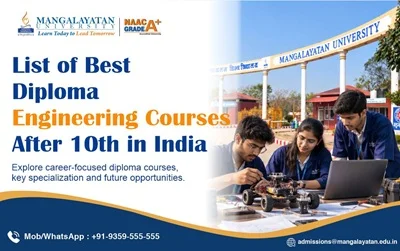
Choosing the right career path after Class 10 is an important decision for students in India. While many students choose the traditional Class 11–12 route before pursuing a degree, others prefer to enter the technical field through a Diploma in Engineering. Diploma engineering courses provide students with practical technical knowledge, industry-oriented skills, and an early opportunity to explore engineering careers.
A diploma can be particularly useful for students who enjoy practical learning and want to develop job-ready skills without spending several years immediately pursuing a conventional engineering degree. From mechanical and civil engineering to computer science and electronics, students can choose from several specialisations according to their interests and career goals.
Quick Answer: Which Diploma Engineering Courses Can You Pursue After 10th?
Popular Diploma Engineering courses after Class 10 include Mechanical Engineering, Civil Engineering, Electrical Engineering, Electronics and Communication Engineering, Computer Science Engineering, Information Technology, Automobile Engineering, Chemical Engineering, Biotechnology and Mechatronics and Automation. Course availability, duration and eligibility vary by institution.
What Is a Diploma Engineering Course?
A Diploma in Engineering, commonly known as a Diploma, is a technical education programme that generally allows students to enter after completing Class 10. Depending on the institution and programme, diploma courses are commonly designed for approximately three years.
Unlike many academic programmes that focus heavily on theoretical concepts, diploma engineering programmes generally combine classroom learning with practical sessions, laboratory work, workshops and technical training. Students learn the fundamentals of their chosen engineering discipline and develop skills that can be applied in industrial and professional environments.
Different Types of Diploma Engineering Courses Available in India
India offers diploma programmes across a wide range of engineering and technology disciplines. Some of the popular options include:
1. Diploma in Mechanical Engineering
Mechanical Engineering is one of the most established diploma specialisations. It covers areas such as manufacturing, machine design, thermodynamics, production processes, engineering drawing and maintenance.
Students can explore career opportunities in manufacturing units, automobile companies, production plants, maintenance departments and engineering industries. The course can also provide a foundation for further study in mechanical engineering and related fields.
2. Diploma in Civil Engineering
A Diploma in Civil Engineering focuses on construction, infrastructure and the built environment. Students generally study surveying, construction materials, structural fundamentals, estimation, building technology and basic environmental engineering.
Career opportunities can be found in construction companies, infrastructure projects, real estate organisations, surveying firms and government-related technical departments, subject to recruitment requirements.
3. Diploma in Electrical Engineering
Electrical Engineering deals with electrical systems, power generation, transmission, distribution, electrical machines and industrial electrical equipment.
A diploma in this field can prepare students for technical roles involving electrical maintenance, equipment installation, testing and operations. Graduates may find opportunities across manufacturing, power, construction, infrastructure and electrical services.
4. Diploma in Electronics and Communication Engineering
This programme introduces students to electronic circuits, communication systems, digital electronics, microprocessors and related technologies.
With electronics becoming increasingly important in telecommunications, automation and embedded systems, students can develop a foundation for technical careers in electronics and communication-related industries.
5. Diploma in Computer Science Engineering
For students interested in computers and technology, a Diploma in Computer Science Engineering can be an attractive option. The curriculum may cover programming, databases, computer networks, operating systems, web technologies and software fundamentals.
Students can develop skills relevant to entry-level roles in software support, web development, IT services, technical support and other technology-oriented areas. They can also continue their education through higher-level computer science and IT programmes.
6. Diploma in Information Technology
A Diploma in Information Technology focuses on the application and management of computer-based technologies. Students may study programming, networking, databases, information systems and web technologies.
The course can provide a foundation for careers in IT support, system administration, networking, software services and related areas.
7. Diploma in Automobile Engineering
Automobile Engineering is suitable for students interested in vehicles, automobile systems and transportation technology. The programme may cover vehicle design fundamentals, automobile engines, transmission systems, servicing, maintenance and manufacturing processes.
Career possibilities include automobile service centres, dealerships, manufacturing companies, workshops and vehicle maintenance operations.
8. Diploma in Chemical Engineering
Chemical Engineering combines engineering principles with chemistry and industrial processes. Students learn about chemical processes, plant operations, materials, industrial safety and process equipment.
Career opportunities may exist in chemical manufacturing, pharmaceuticals, petrochemicals, food processing and other process industries.
Biotechnology-related diploma programmes introduce students to biological processes, laboratory techniques and applications of biotechnology. Depending on the institution, students may study areas related to microbiology, biochemistry, genetics and industrial biotechnology.
This option can be considered by students interested in the intersection of biology, technology and laboratory-based applications.
10. Diploma in Mechatronics and Automation
Modern industries increasingly use robotics, automation and intelligent manufacturing systems. Diploma programmes in mechatronics and automation combine elements of mechanical engineering, electronics, electrical systems and automation.
Students can build skills relevant to industrial automation, robotics, manufacturing systems and maintenance.
Diploma Engineering Courses After 10th: Quick Comparison
The following overview shows a comparison of the major specialisations mentioned above. The programme and career opportunities may differ between schools.
Diploma Engineering Course
Main Areas Covered
Suitable For
Diploma in Mechanical Engineering
Manufacturing, machines, production and maintenance
Students who have an interest in machines and manufacturing
Diploma in Civil Engineering
Construction, surveying and infrastructure
Students who are interested in construction and infrastructure
Diploma in Electrical Engineering
Electrical systems, machines and power
Students interested in electrical systems and equipment (electrical systems, machines and power)
Diploma in Electronics & Communication Engineering
Electronics, digital systems and communication
Students who are interested in electronics and communication technologies.
Diploma in Computer Science Engineering
Programming, databases, networks and software
Students interested in computers and software technologies
Diploma in Information Technology
Programming, networking, databases and IT systems
Students interested in information technology and computer systems
Diploma in Automobile Engineering
Vehicles, engines, servicing and maintenance
Students with an interest in automobiles and vehicle technology
Diploma in Chemical Engineering
Chemical processes, plant operations and process equipment
Students interested in chemical process and industry jobs.
Diploma in Biotechnology Engineering
Biotechnology, laboratory techniques and biological applications
Students who like and have an interest in biology and technology
Diploma in Mechatronics & Automation
Mechanical systems, electronics, automation and robotics
Students interested in automation and robotics
Why Choose a Diploma After 10th?
One of the biggest advantages of pursuing a diploma after Class 10 is early exposure to technical education. Students begin learning their chosen engineering discipline instead of spending the next two years primarily preparing for a general academic stream.
Practical Learning
Diploma programmes generally emphasise laboratory work, workshops, technical assignments and practical applications. This can help students understand how engineering concepts are used in real-world situations.
Development of Job-Oriented Skills
Students can acquire technical skills that may be useful for entry-level employment. Depending on their specialisation and additional skills, diploma holders can pursue roles such as technician, junior technical assistant, CAD operator, maintenance technician, site supervisor or technical support professional.
Opportunity for Higher Education
A diploma does not necessarily have to be the end of a student's academic journey. Students who meet the relevant eligibility and admission requirements can pursue higher education, including B.Tech/B.E. through lateral-entry pathways where available.
Early Career Exposure
Since students enter technical education immediately after Class 10, they can potentially gain professional exposure earlier than students following only the traditional academic route. Internships, industrial visits, practical projects and apprenticeships can further strengthen their employability.
A diploma can shape a student's future by establishing a strong technical foundation at an early stage. However, the long-term value of the qualification depends on the student's specialisation, institution, practical skills, academic performance and willingness to continue learning.
For example, a student interested in machines may choose Mechanical Engineering, while someone fascinated by technology may prefer Computer Science or Information Technology. Similarly, students interested in construction can explore Civil Engineering, whereas those interested in electrical systems may consider Electrical Engineering.
The skills acquired during a diploma can also help students understand their professional interests before deciding whether to pursue a bachelor's degree. This makes the diploma route useful for students who prefer a practical and career-oriented approach.
Diploma Engineering Courses Offered at Mangalayatan University
Mangalayatan University Aligarh provides the following Diploma Engineering programmes, regular programmes are 3 years duration with 45% marks in class 10:
Diploma in Electronics & Communication Engineering (ECE)
3 Years
45% marks in 10th
Career Growth After a Diploma in Engineering
After completing a diploma, students can consider several pathways. The first is employment, where they can apply for suitable technical and junior-level positions in the private sector or pursue opportunities for which they meet the prescribed eligibility criteria.
The second pathway is higher education. Students can pursue B.Tech/B.E. through lateral entry where permitted. Completing a bachelor's degree can open additional professional and academic opportunities.
Students can also strengthen their profile through certifications in areas such as CAD, programming, networking, automation, data analysis, cybersecurity or other technologies relevant to their specialisation.
Begin your Engineering Journey with a Diploma Engineering Program
Why Choose Mangalayatan University for Diploma Engineering Courses?
Mangalayatan University provides career-focused Diploma Engineering programmes that effectively blend sound theoretical knowledge with experiential learning. Students benefit from well-equipped laboratories, knowledgeable faculty, practical training and competency-based education. Through a wide range of engineering specialisations, professionally aligned learning and valuable development opportunities, the university enables students to strengthen their technical capabilities, confidence and foundation for pursuing higher studies or building successful careers.
Conclusion
A Diploma in Engineering after Class 10 can be an effective pathway for students who want to enter technical education early and develop practical skills. With specialisations ranging from Mechanical, Civil and Electrical Engineering to Computer Science, Information Technology, Electronics, Automobile Engineering and Automation, students have numerous options to match their interests.
The right diploma course can provide technical knowledge, practical exposure and a foundation for employment or further education. However, students should carefully evaluate the course curriculum, institution, recognition, practical facilities, admission requirements, career opportunities and possibilities for higher education before making a decision.
Ultimately, a diploma is not simply a shorter route into engineering—it can be the first step towards building a technical career, gaining industry exposure and progressing towards higher qualifications.
Diploma Engineering Courses After 10th Related FAQs
Q1 - Which diploma engineering course is best after 10th?
After 10th, the learner should take up that course which suits his area of interest and career goals. It will help to upgrade his/her skill with utmost potential. Core branches for engineering include Mechanical, Electrical and Electronics, Computer Science, Civil, and Communication Engineering.
Q2 - Can I do a diploma in engineering after Class 10?
Yes, There are many prestigious institutions that offer Diploma Engineering courses after class 10th. You just need to fulfill the eligibility criteria.
Q3 - How many years is a diploma engineering course after 10th?
After class 10th, the Diploma course approximately is a three year course programme but can vary institution wise as well.
Q4 - Can I do BTech after a diploma?
Yes, After Diploma Engineering you can always do BTech/B.E. Engineering which would help you upgrade your skill & technical know how.
Q5 - What is the eligibility for Diploma Engineering at Mangalayatan University?
For pursuing Diploma Engineering programmes. From Mangalayatan University the students must have passed 10 grade.
ADMISSION OPEN
Unlock Your Potential with World-Class Education
Choose from diverse programs designed to prepare you for global opportunities. Your future begins here.
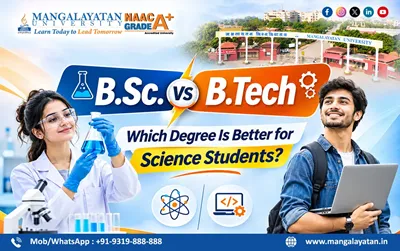
Selection of an apt undergraduate degree program after Class 12 will assist in determining not only the course of study but also the career choices for that particular person. Choosing between the BSc vs BTech degree programs is perhaps one of the most common choices made by students pursuing their education in the science stream with an interest in studying the subjects.
Awareness about the BSc vs BTech difference could prove to be quite useful when making a choice regarding the program best suited for you.
What Is a BSc Degree
Bachelor of Science is an undergraduate program which comprises scientific knowledge and subject knowledge in terms of science theories, science experiments, and scientific ideas. Specialisations depend on the interest and eligibility of the students.
Some of the courses which are taught at the University of Mangalayatan are BSc PCM (Physics, Chemistry, and Mathematics), BSc ZBC (Zoology, Botany, and Chemistry), BSc Biotechnology, and BSc Agriculture. Some of these courses might interest those who want to study science.
Also Read - BSc Course Details, Full Form, Admission, Fees, Syllabus, Top Colleges, Career
What Is a BTech Degree?
Bachelor of Technology (BTech) is an engineering course of study that is concerned with using science and mathematics knowledge to resolve real-life problems. This BTech course is a blend of engineering theory, laboratory exercises, and projects.
Mangalayatan University provides various BTech programmes like Computer Science Engineering, Artificial Intelligence and Machine Learning, Cyber Security, Data Science, Civil Engineering, Mechanical Engineering, and Electrical Engineering. Such BTech courses could be suitable for those who have an interest in technology and engineering solutions.
Read Also - BTech Course Details, Full Form, Eligibility, Duration, and Career
BSc vs BTech Difference: Key Comparisons
The main BSc vs BTech difference is in terms of the mode of study and professional path. Typically, the BSc programme concentrates on science, whereas BTech concentrates on technology.
FactorBScBTech
Full form
Bachelor of Science
Bachelor of Technology
Main focus
Scientific concepts and research
Engineering and technology
Course duration
Usually 3–4 years, depending on programme
Usually 4 years
Learning approach
Theory, experiments and subject-based study
Technical theory, practical training and projects
Common subjects
Physics, Chemistry, Mathematics, Biology
Programming, Engineering Mathematics, Electronics, Mechanics
Career areas
Research, laboratories, education and science-related industries
IT, engineering, manufacturing and technology
Further studies
MSc, specialised postgraduate courses, PhD
MTech, MBA and specialised postgraduate courses
Course duration and subject combinations vary by specialisation and university.
Read Also - Top Courses After 12th in India 2026 -27 | Best Career Options, Salary & Scope
Eligibility and Admission Requirements
Students are advised to go through the admission guidelines to determine which one to opt for, either BSc or BTech.
For Mangalayatan University, some of the general criteria for both programs are:
BSc: Eligibility is based on the field of study. In most of the cases, the science courses require that the candidates should have studied Class 12 with the necessary subjects along with obtaining the necessary marks percentage.
BTech: The listed engineering courses generally require candidates to have completed Class 12 with Physics, Chemistry, and Mathematics or other prescribed combinations of subjects with a minimum of 50 per cent marks.
Admission: Selection criteria could be different for each course and may depend on grades, exams or any other university requirement.
Refer to the current course web page for specific qualifications.
Read Also - Top Courses After 12th for Science Students: High Salary, Career Options & Scope
BSc vs BTech Career Scope
The choice between BSc vs BTech career scope degrees varies according to specialization, experience, skills, and higher qualifications.
For those holding a BSc degree, various career paths like laboratory assistant, research assistant, quality control, agri-based jobs and teaching positions are available based on specialization and eligibility criteria.
BTech graduates can explore various options in fields such as software development, engineering, cybersecurity, data analysis, manufacturing and project management based on their specialization.
DegreePotential Career Options
BSc
Laboratory Assistant, Research Assistant, Quality Control Assistant, agriculture-related roles
BTech
Software Developer, Civil Engineer, Mechanical Engineer, Cybersecurity Analyst, Data Analyst
These are potential career paths; not guaranteed job outcomes.
BSc or BTech: Which Is Better?
The choice of BSc or BTech, which is better, depends on your preferences and future goals.
If you like science subjects, experiments, research and acquiring more knowledge about the subject for higher education, then go for BSc.
If you like practical applications of engineering, solving problems, design and dealing with technology, then choose BTech.
Do a cost comparison, duration comparison and other comparisons regarding career requirements.
Neither degree is automatically better for every student.
Read Also - Top Courses After 12th for Arts Students: High Salary, Career Options & Scope
Why Choose Mangalayatan University?
Mangalayatan University Aligarh provides courses in science and engineering in various specializations. One may find undergraduate science courses in applied sciences, biotechnology, and agriculture in addition to the engineering and technology degrees in B.Tech course offerings.
It is necessary to check out the syllabi, faculty details, laboratories, costs, and eligibility conditions on the website before applying for any program. This will allow you to pursue an area according to your interest.
Conclusion
The BSc vs BTech choice will depend on whether you are inclined towards scientific education or engineering application. A BSc education may offer you basic science and research knowledge, whereas a BTech education will offer you technical education and engineering applications. Just compare the specialization opportunities available for both to make an informed decision.
M.Pharm in Pharmaceutics degree opens up lots of possibilities for jobs that involve research, development, manufacturing, quality assurance, and other such roles within the pharmaceutical sector. The two-year course is focused on the field of pharmaceutics. M.Pharm in Pharmaceutics at Mangalayatan University focuses on developing scientific skills and expertise for the pharmaceutical industry.
What Can You Do After M.Pharm in Pharmaceutics?
After finishing an M. Pharm in Pharmaceutics program, there are options like formulation development, research and development in the pharmaceutical industry, manufacturing, quality control, quality assurance, and regulatory affairs that can be chosen for a career. Also, options like clinical research, pharmacovigilance, medical writing, and academics are also available.
Choosing the correct career path is a function of the passion, technical skill and goals of the individual in the pharmaceutical industry.
Career Options After M.Pharm in Pharmaceutics
The major career options after M.Pharm in Pharmaceutics include:
Job RoleKey Responsibility
Formulation Scientist
Develop and improve pharmaceutical formulations
Research Scientist
Conduct pharmaceutical research and product development
Production Manager
Manage manufacturing processes and production activities
Quality Control Professional
Test medicines and maintain quality standards
Quality Assurance Professional
Ensure processes follow quality and compliance requirements
Regulatory Affairs Professional
Handle documentation and regulatory requirements
Formulation Scientist
A formulation scientist is responsible for the development and enhancement of medicines, particularly the drug delivery systems and dosage forms. This profession requires thorough knowledge of pharmaceutics and laboratory skills.
Read Also - M. Pharm Course Details: Full Form. Admission, Eligibility, Duration, Fees, Colleges, Jobs
Research Scientist
Research scientists specialize in drug research and development and product development. Mangalayatan University has mentioned research scientist and formulation development scientist among career options after M. Pharm in Pharmaceutics.
Production Manager
Production experts manage pharmaceutical manufacturing operations, production procedures, paperwork and flow. Graduates with enough experience can get into management roles.
Quality Control Professional
Quality control personnel are responsible for testing drugs and their raw materials to verify whether they conform to existing standards. Analytical and laboratory expertise are vital for this profession.
Quality Assurance Professional
Quality assurance specialists deal with systems, documentation, compliance, and process quality. They provide standards compliance during the manufacturing of medicines.
Regulatory Affairs Professional
Individuals who are part of the regulatory affairs department manage all matters pertaining to regulatory documentation.
Higher Studies After M.Pharm in Pharmaceutics
Students interested in advanced research can pursue higher studies after M.Pharm, including a PhD in Pharmacy.
Pharmacy program is another area where Mangalayatan University provides PhD research programs in pharmaceutics, pharmacology, clinical pharmacy, and computer-aided drug design.
Read Also - B.Pharm vs D.Pharm vs M.Pharm: Eligibility, Scope, Salary & Career Comparison
Skills to Develop After M.Pharm in Pharmaceutics
Important skills for building an M.Pharm in Pharmaceutics career include:
Formulation development and drug delivery knowledge
Laboratory and analytical skills
Research methodology
Quality control and assurance practices
Regulatory documentation
Data analysis and scientific writing
Communications and problem-solving skills
M.Pharm Pharmaceutics Salary and Career Growth
M.Pharm Pharmaceutics Salary can vary depending on several factors like the nature of work, location, company, experience, and specialisation. Generally, freshers begin their career at the fundamental level of Research & Development, Manufacturing, Quality Assurance, Quality Control and Regulatory Affairs.
An individual may progress within his career and achieve positions such as senior scientist, specialist, manager, and leader.
Government and Private Jobs After M.Pharm
Jobs after M.Pharm are available across both government and private sectors. Private opportunities include research scientist, formulation scientist, QA/QC professional, production professional and regulatory affairs roles.
M.Pharm government jobs could become accessible in drug regulations, research facilities, health care organizations and training, based on recruitment criteria.
Read Also - Pharm D Course Details: Full Form, Eligibility, Fees, Admission, Top Colleges and Scope
Career Opportunities in Pharmaceutical Research and Manufacturing
M.Pharm career prospects in India are numerous and range from formulations development to manufacturing, quality control, clinical trials, regulatory affairs, and academic research. M.Pharm students have various options such as
Job opportunities in M.Pharm Pharmaceutics vary based on the ability and interest of people. Using the technical and analyzing skills that people have, graduates from M.Pharm can establish careers in various sectors of the pharmaceutical field.
Why Choose Mangalayatan University Aligarh for M.Pharm in Pharmaceutics?
Mangalayatan University Aligarh has a two-year M.Pharm in Pharmaceutics course. This course covers theoretical studies, practical training, research works and dissertation writing. Mangalayatan University claims that this course is recognized by Pharmacy Council of India.
School of Pharmacy, in particular, focuses on the advanced laboratories, experienced faculty members, research, conferences, and developing soft skills. In addition to that, this university also organizes industrial visits, projects, recruitment drives, and career counseling.
Conclusion
A Master of Pharmacy in Pharmaceutics has a number of avenues in pharmaceutical research, formulation, manufacturing, quality, and regulation. Technical and research abilities can aid the graduates in rising from an entry-level job to specialised and managerial positions.
Selection of a program that involves practical training, research exposure, and industry orientation would be useful for developing one’s career in pharmacy in the long run.
The career path after PGDBM in India can provide scope in the fields of business management, marketing, finance, human resources and strategic management. On completing PGDBM course, students can find work as they clear the exam or can go for higher studies.
PGDBM programme encourages students to grow managerial, analytical, and decision-making abilities to make a career in several sectors of business and management.
What Can You Do After PGDBM?
Job Opportunities after PGDBM Business Development, marketing, HR, Operations, Sales & Consulting jobs are available for PGDBM graduates. The PGDBM career scope also include finance, entrepreneurship, project management and other business areas.
Depending on the specialisation, work experience, communication skill and interest of the candidate, they can look for wide range of career options after PGDBM.
Career Options After PGDBM in India
Some common jobs after PGDBM include:
Job RoleKey Responsibility
Business Development Manager
Identify opportunities and develop business relationships
Marketing Executive
Plan and support marketing activities
Human Resources Executive
Manage recruitment and employee-related functions
Operations Executive
Coordinate processes and business operations
Sales Manager
Manage sales activities and customer relationships
Management Consultant
Analyse business challenges and suggest solutions
Business Development Manager
As a business development manager, you\'ll identify future markets and business partners. You will establish and develop business relationships and take a new business to the next level. Strong communication, negotiation and market research skills will be necessary.
Read Also - MBA vs PGDM: Which Course is Better for Your Career?
Marketing Executive
Marketing executives are responsible for campaigns, market research, customer engagement and promotional activities. An understanding of consumer behaviour, branding and digital marketing can help students open up various PGDBM career opportunities.
Human Resources Executive
HR executives help recruit new employees, manage their orientation, and ensure they are engaged with the workplace, managing training and personnel administration. Good people skills and effective communication ability are essential for a career in this field.
Operations Executive
Operations executives oversee the daily running of the organisation in terms of management of people, resources and processes. This role could be of interest to those who graduate with an interest in operations, logistics and organisation.
Sales Manager
Sales managers manage their team as well as take charge of sales activities and customer relations. They can analyse market trends and prepare sales targets and strategies to bring in growth in the business.
Management Consultant
Management consultants study organisational problems and develop solutions as they work through areas of strategy, operations, marketing or other aspects of the business. They use analytical thinking and have strong communication and problem solving skills.
Higher Studies After PGDBM
Higher education options for PGDBM students: A student can go for an MBA or other high-end, specific management courses to further their expertise in the domain. Common specialisations are finance, marketing, business analytics, HR management and operations.
PGDBM business management course students can pursue certifications in the relevant industry domain. Your choice of higher studies after PGDBM will be influenced by your career goals, interests, and your domain to work in.
Skills to Develop After PGDBM
To strengthen PGDBM career opportunities, students should develop:
Communication and presentation skills
Leadership and team management
Business and analytical thinking
Problem-solving and decision-making
Data interpretation
Digital and technology skills
Negotiation and time management
Career Advancement Cell: Communicative skills, presentation skills, leadership qualities, team management skills, time management skills, interview skills and other employability skills are given importance in the Career Advancement Cell of Mangalayatan University.
Read Also - PGDM Course Details: Full Form, Admission, Eligibility, Entrance Exam, Fees, and Colleges
PGDBM Salary and Career Growth in India
PGDBM salary in India also varies based on various parameters like job profile, organisation, industry, location, skills and experience. PGDBM graduates, after completing the course, can get into sales, marketing, HR, operations and business development as a fresher.
With years of experience and acquired specialisation, the PGDBM Candidates can get the opportunity of working as a senior executive, manager, expert and leader in various industries.
Government and Private Jobs After PGDBM
There are a lot of government jobs after PGDBM that can be available through competitive exams and recruitment, but it depends on the eligibility criteria of the positions. The private jobs after PGDBM include jobs in areas of marketing, sales, HR, finance, operations, business development and consulting. Opportunities in various industries depend on the student\'s skills, qualifications, experience and the organisation\'s needs.
Career Opportunities in Business Management
PGDBM Career Opportunities – After PGDBM career scope is marketing, human resources, finance, sales and business development, and operations. You may opt for the ones which fit your interests and strengths.
The scope of career after PGDBM as as per Mangalayatan University are as a Business Development Manager, as a Marketing Manager, as a Human Resource Manager and many more options are there for students in the field of business management.
Read Also - What Is an MBA? Course Details, Eligibility, Fees, Salary & Scope
Why Choose Mangalayatan University for PGDBM?
Mangalayatan University Aligarh offered a 2-year PGDBM programme spread over 4 semesters. The programme introduces students to different areas of managerial practice, including marketing management, financial management, human resource management, business communication, operations management, strategic management and business law. Mangalayatan University PGDBM programme also features case studies, participative learning and real-life applications to enhance managerial and hands-on competencies.
Masters in Business Administration (MBA) Career Advancement initiative at the university can involve developing soft skills, communication and presentations skills, interviewing and team building skills.
Conclusion
The career path after PGDBM in India can span across various business and managerial roles. A PGDBM graduate can start at an executive level, and acquire skills to move towards managerial roles with a specialised skill set. Creating effective communication, analysis and problem solving skills, and building managerial qualities can enable PGDBM professionals to meet dynamic business demands.?